.avif)
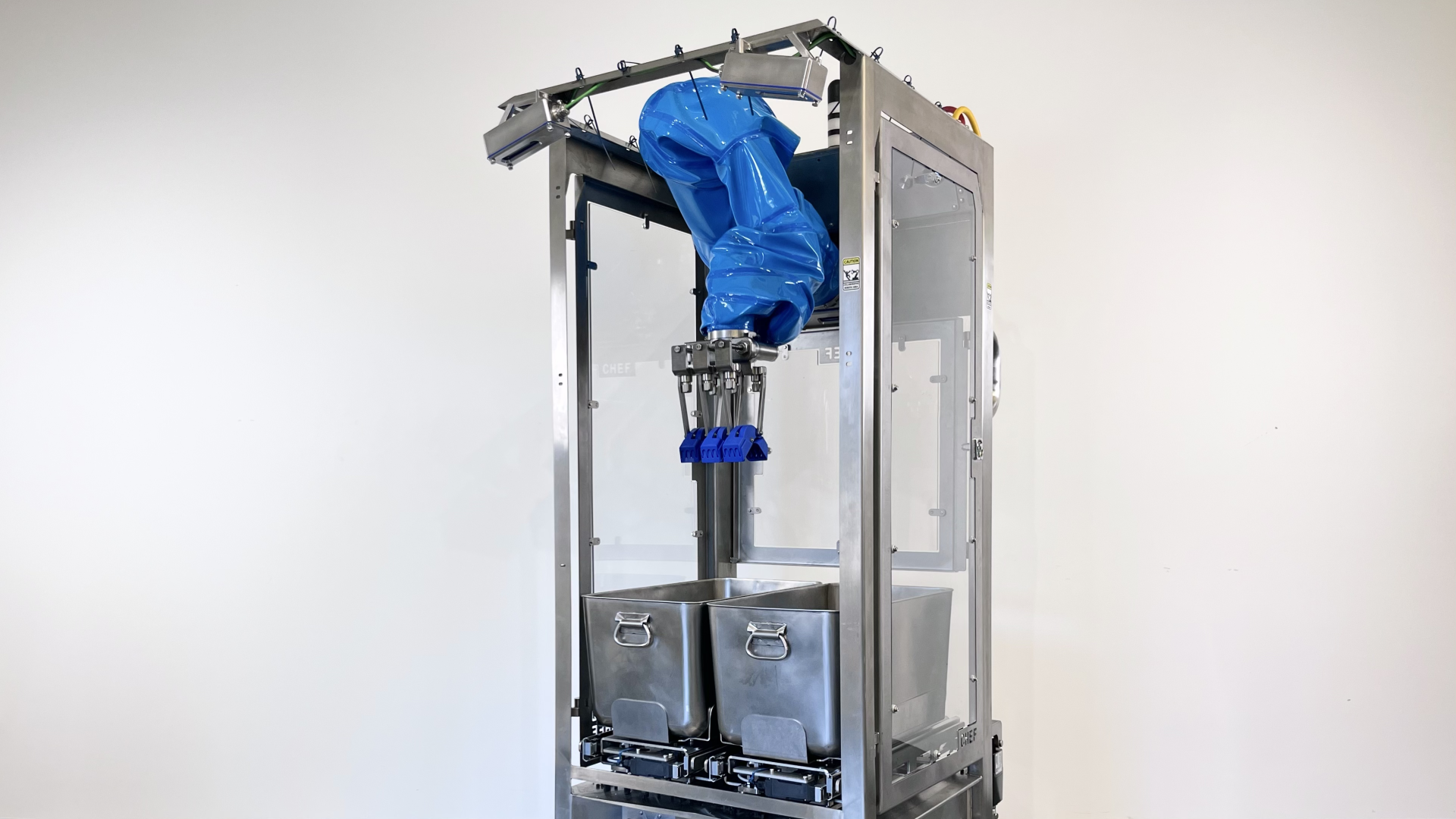
Imagine a breakfast tray moving down a production line. One compartment needs a scoop of oatmeal, portioned by weight; another needs a sausage patty, picked and placed flat; and all this is followed by a hot sauce packet, dropped in before the tray is sealed. All three steps occur in sequence at production speed, and all three now fall within the tasks Chef robots can handle.
Breakfast tray assembly is a labor-intensive step in institutional food production. For manufacturers supplying K–12 school nutrition programs, hospital food service, airline catering, and correctional facilities, breakfast trays are produced in high volumes daily. Quick changeover windows, early shift start times, multiple SKUs, and tight compliance requirements make manual assembly difficult to sustain at scale.
How Chef robots handle breakfast tray assembly
Chef robots handle breakfast tray assembly using two existing capabilities, piece-picking and scooping, depending on the ingredient.
For discrete items such as breakfast sausage links, sausage patties, egg patties, hash browns, tater tots, biscuits, pancakes, waffles, French toast sticks, fruit cups, cheese portions, bacon strips, turkey sausage patties, and muffins, Chef robots use the piece-picking capability to pick and place items precisely into the correct compartment of each tray or bowl without damaging them.
For scoopable ingredients such as oatmeal, grits, yogurt, scrambled eggs, cottage cheese, home fries, breakfast potatoes, baked beans, and fruit compote, the scooping capability portions ingredients by weight and places them accurately using Chef’s tray-tracking vision system.
For assembling components such as hot sauce packets, condiment pouches, seasoning sachets, and cutlery kits, Chef robots use the same piece-picking capability to identify each item’s position and orientation in the bin and place it precisely into the correct location within the tray, handling the variability of lightweight, flexible packaging that shifts and crinkles between picks.
All three capabilities are built on physical AI models trained across diverse real-world production environments, allowing Chef robots to adapt to variability in how ingredients and components sit in the pan or bin with no pre-sorting or fixed placement required.
Breakfast tray production lines are also largely manual environments. Chef robots are designed to work alongside people throughout the shift, handling real-world variability such as workers accelerating or decelerating the conveyor, adding or removing trays mid-line, or bumping into trays the robot has already detected.
Three AI-powered placement capabilities for breakfast tray assembly
Depending on the SKU, Chef robots provide three distinct placement capabilities to meet these requirements:
- Offset placement: Chef’s camera system identifies the exact center of each tray and uses it as a reference point for every deposit. Each item is placed at a predefined offset from that center. For example, when assembling a three-item breakfast tray, the robot can be configured to place a sausage link at the center, a hash brown eight centimeters to the left, and an egg patty eight centimeters to the right, ensuring every tray has a uniform, consistent arrangement regardless of how trays arrive on the conveyor.
- Stacked placement: For breakfast burgers and similar stacked assemblies, ingredients must be layered in a specific order. Chef robots can be configured to place the bottom bun first, stack a beef patty on top, add a cheese slice, and finish with the top bun, thereby building the full assembly in the correct sequence without manual intervention between picks.
- Precise angular placement: Many breakfast tray SKUs require items to land in a specific orientation—a sausage link placed lengthwise along a compartment, or a veggie patty seated flat to prevent shifting during downstream sealing. Chef’s vision system detects the angle at which each item sits in the pan and reorients it after picking, ensuring it arrives at the exact angle required regardless of its original position in the source container.
What this means for food manufacturers
For institutional food service manufacturers, breakfast lines often run under the tightest schedules of the day, with little room to absorb staffing gaps or slowdowns. Chef’s breakfast tray assembly solution offers higher throughput, lower labor dependency, and consistent portion presentation across shifts.
The solution works across a wide range of breakfast ingredients, components, and tray formats without requiring changes to existing production line infrastructure, making it straightforward to deploy across different SKUs and facility types.
What’s next
Interested in learning more about Chef’s capabilities? Contact us to discover the full range of applications our robots are running for industry-leading food manufacturers.