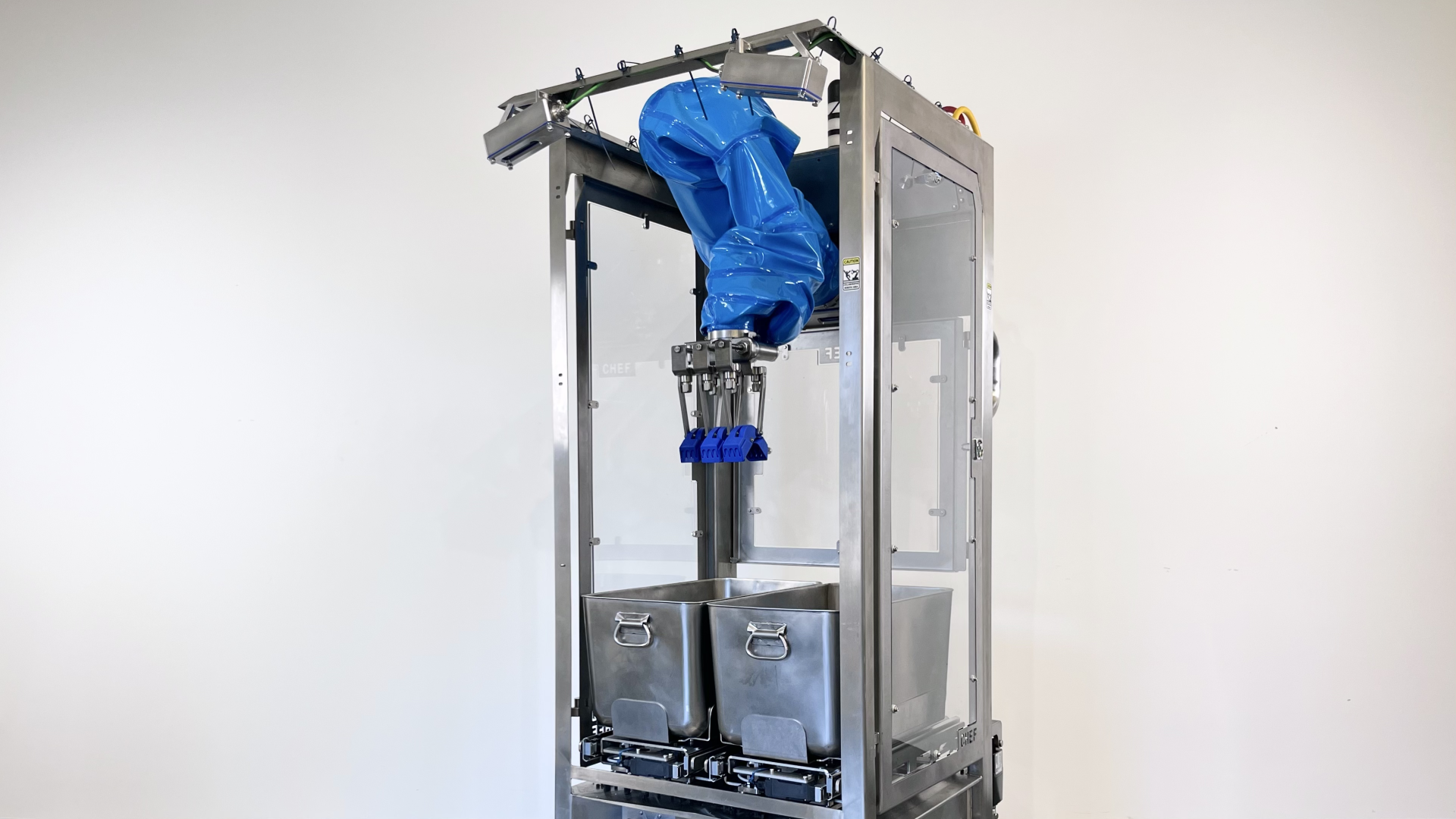
“What’s the ROI?” It’s one of the most common questions we hear from food manufacturers evaluating robotic automation, and it’s a fair one. Chef operates on a robotics-as-a-service (RaaS) model: instead of buying equipment outright, manufacturers pay a flat annual fee that covers the robot, software, and support, similar to how software-as-a-service (SaaS) changed how companies buy software. RaaS is still a relatively new model for most operators, and any new spend requires a clear return on investment.
ROI depends on labor cost, ingredients, and production volume. There isn’t a single number that applies to every manufacturer, but the levers are consistent across every deployment we run. ROI with Chef comes from five places: labor, production capacity, food giveaway, throughput, and safety.
1. The true cost of labor
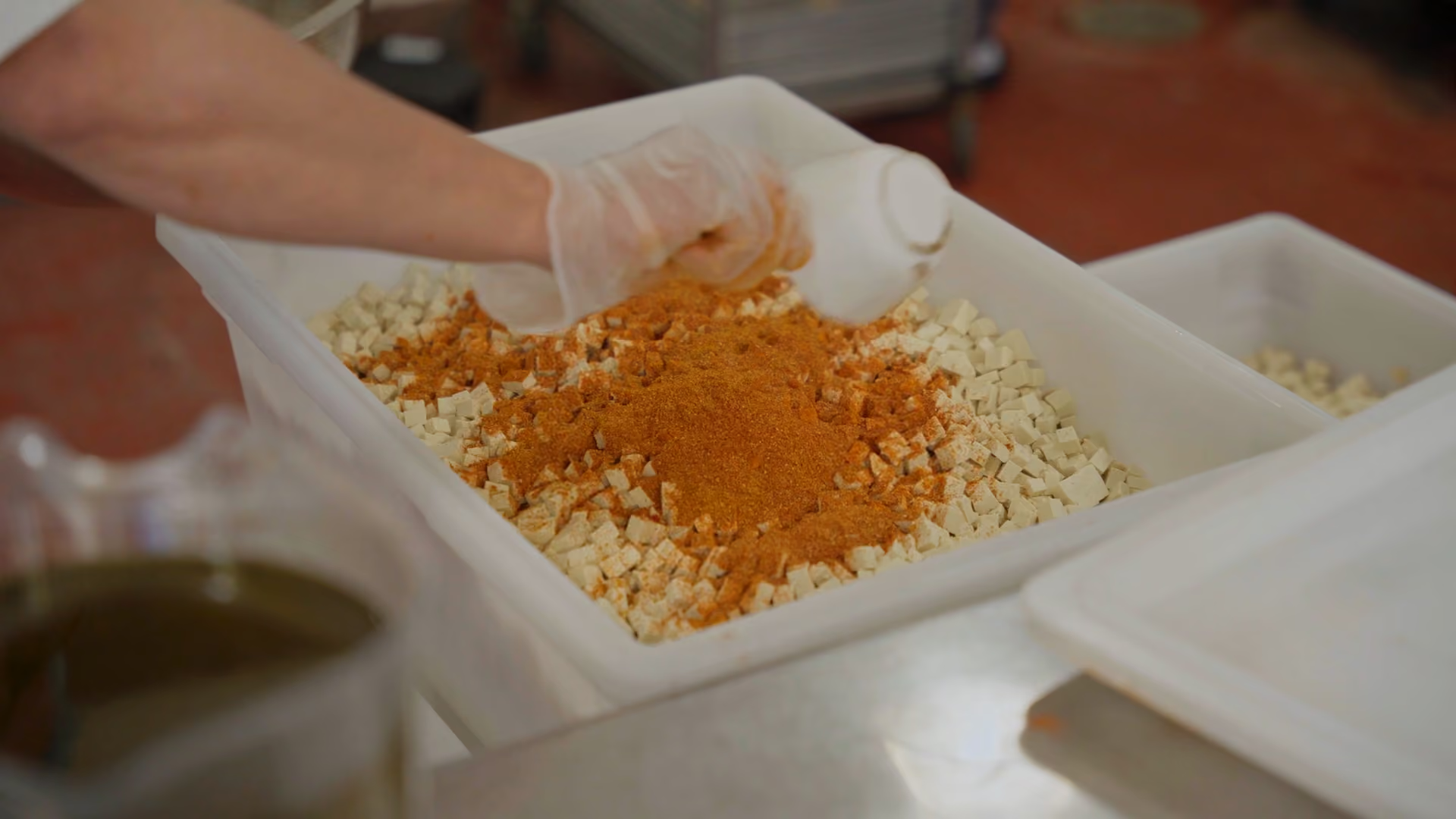
Meal assembly and portioning have traditionally relied on manual labor. The work is repetitive, physically demanding, and increasingly difficult to staff:
- Annual turnover regularly exceeds 150% in the food manufacturing industry.
- An estimated 1.1 million jobs sat unfilled in the industry in 2023 alone.
- The labor shortage could cost food manufacturers $1 trillion by 2030.
This shortage affects a manufacturer's ROI in two ways:
Rising labor costs
Even when a manufacturer can fully staff a line, the wage on the paycheck is only part of the cost. A workstation also carries payroll taxes, workers’ compensation, health insurance, benefits, recruiting, onboarding, training, and line lead management, and with turnover this high, manufacturers pay those costs over and over again.
Chef replaces these costs with a single, predictable RaaS fee. The fee is priced at a discount to labor, so manufacturers pay less per robot per year than the all-in annual cost of workers at that station. There’s no recruiting, no retraining, and no overtime to cover for a worker who doesn’t show up. A production line also needs a full crew to run; even one unfilled position can idle the line for an entire shift. Chef robots fill those gaps.
2. Idle lines are lost revenue
For many manufacturers, the labor shortage doesn't just raise costs; it caps revenue. A production line needs a full crew to run, and when there aren't enough line workers to staff it, the line sits idle along with the capacity it represents. The equipment exists, the demand exists, but the output never happens.
Chef robots fill those staffing gaps and let idled lines run again. Every line that returns to production turns equipment and floor space a manufacturer has already paid for into revenue, without hiring or expanding the facility.
3. Food giveaway cuts into a manufacturer’s margin
Food giveaway is the excess portion of food beyond its target weight. Manufacturers need to avoid underweight servings, but that often leads to overfilling. For food manufacturers, raw ingredients typically account for 40-50% of revenue, so even small amounts of over-portioning compound into significant losses over time.
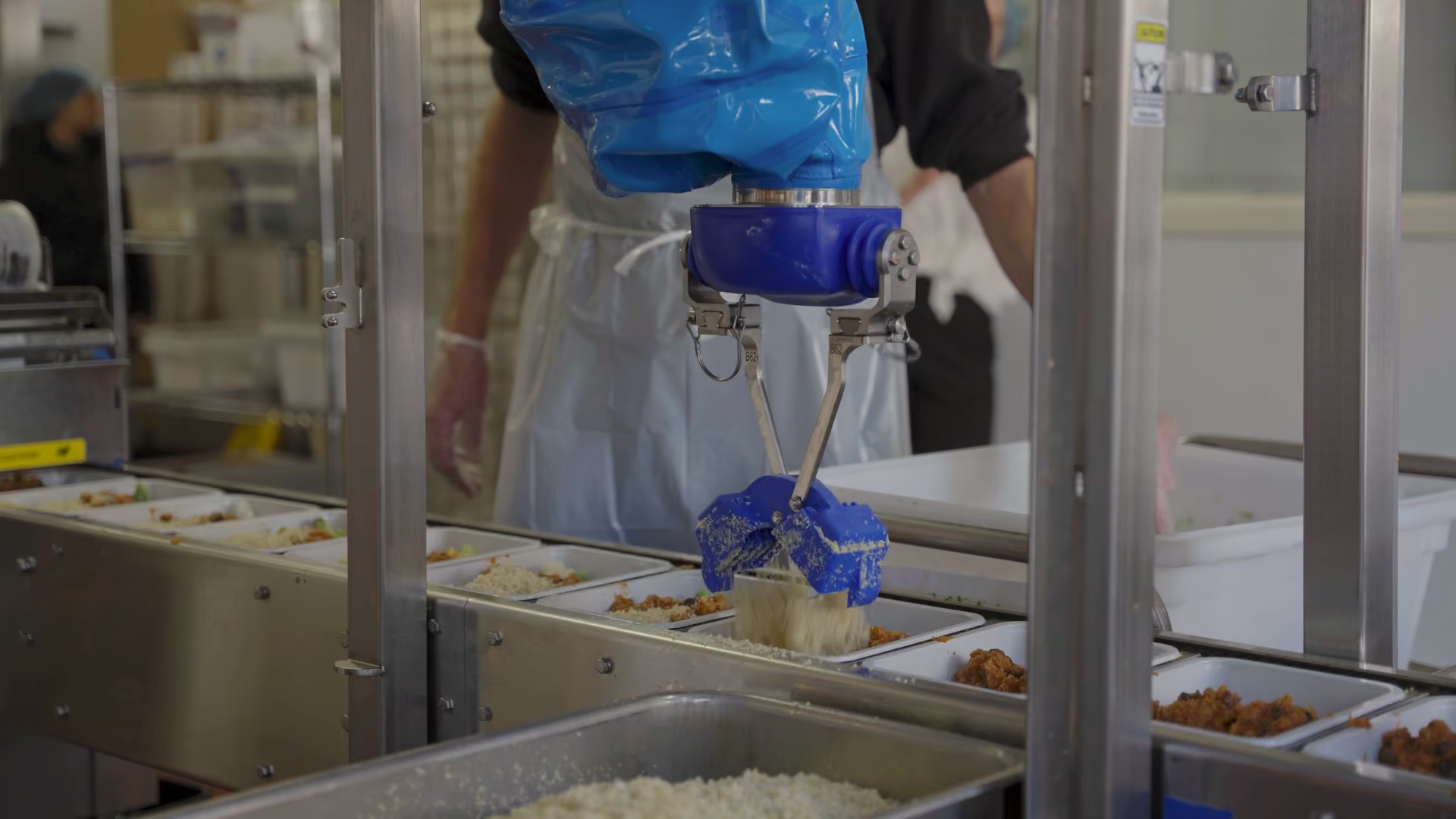
Line workers tend to portion with a slight positive bias. It's safer to go a little over than risk an underweight tray. This bias adds up fast across millions of trays a year. Chef robots portion each deposit with a consistency that's difficult for a person to maintain across an entire shift. The result is less giveaway: food manufacturers using Chef robots have seen up to 88% less giveaway. For many new customers, this is the first ROI lever to deliver measurable results.
Giveaway also creates a second, less visible kind of waste. If line workers over-deposit one ingredient during the first hours of a production run, its supply runs out before the batch is complete. The remaining trays can't be finished, and every other ingredient already staged for them is discarded as well. Because Chef robots portion every deposit to its target weight, ingredient supply lasts the full run.
4. Higher throughput enables higher revenue
Chef robots are built as a 1:1 worker equivalent. They match the pace and footprint of a person on the production line, allowing manufacturers to adopt partial automation without retrofitting existing lines. Many customers exceed that baseline.
Human throughput also varies over a shift, with peaks and slowdowns. Chef robots maintain a steady pace, which raises the average throughput throughout the run.
With robot-to-robot (R2R) communication, multiple Chef robots can coordinate deposits on the same conveyor to reach higher speeds. Food manufacturers running Chef robots have reported 2-3x increases in output and up to a 60% boost in labor productivity.
Every additional meal produced during a shift adds incremental revenue, without adding headcount or floor space.
5. Safety is an ROI lever too
There are two types of safety that play an integral role in Chef’s ROI:
- Human safety: Workers scoop and portion food for hours in 32°F cold rooms. This physically demanding work leads to repetitive strain injuries, workers’ compensation claims, lost shifts, and turnover. Chef robots take on this repetitive work and are designed to operate safely alongside people, per ISO/TS 15066:2016, freeing up workers to focus on higher-value tasks.
- Food safety: When manufacturers use Chef robots, the number of hands involved in food assembly drops sharply; only Chef’s utensils and pans touch the food. The robot hardware is NSF-certified and built to withstand daily washdowns with hot water and caustic chemicals. Fewer touchpoints mean fewer chances for contamination from allergens and bacteria, and fewer contamination risks mean fewer recalls. This is one of the most expensive problems for a food manufacturer.
Why fixed automation falls short on high-mix lines
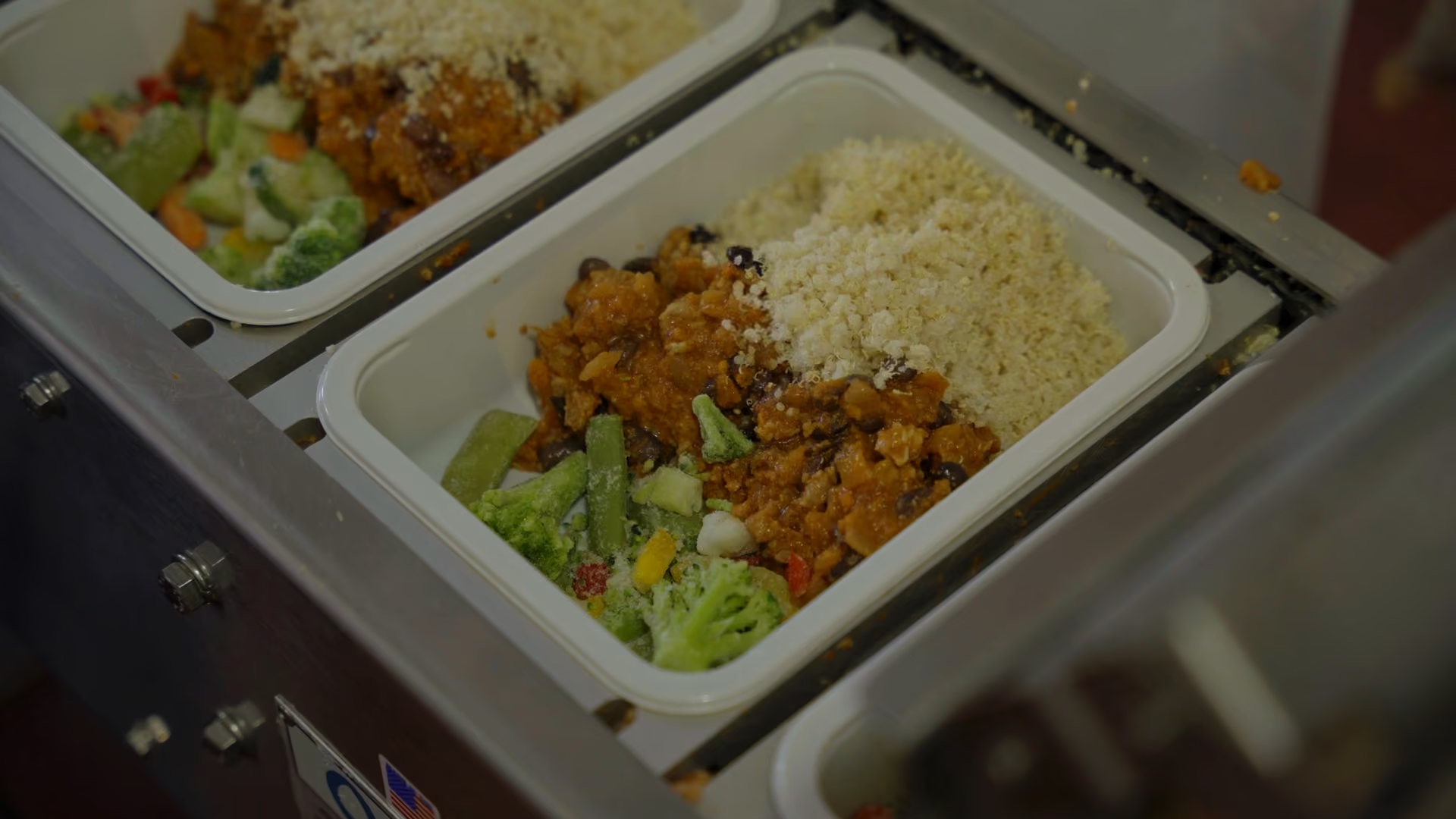
Traditional depositors and dispensers are typically purchased as capital equipment and amortized over their useful life, whereas robotics-as-a-service (RaaS) shifts that investment to an operating expense, showing ROI from day one. As traditional depositors and dispensers are typically configured for a specific product or a narrow family of products, rather than hundreds of SKUs, the moment a high-mix line requires a changeover, either the automation can’t handle the new ingredient, or it needs custom retooling, delaying ROI even further.
Chef robots adapt to ingredient variability, so the same robot that scoops rice today can scoop curry tomorrow, with changeovers measured in minutes, not hours. This flexibility is what keeps the ROI intact as SKUs shift.
RaaS: ROI without the capital risk
Buying new equipment usually requires a large upfront capital investment; that’s the money a manufacturer must spend before seeing any return. Chef’s RaaS model removes that hurdle. Because labor is already an operating expense, replacing it with a RaaS fee is an opex-to-opex swap that requires no capex cycles. Manufacturers pay a flat annual fee, deploy in days or weeks rather than months, and scale the number of robots up or down as demand shifts.
As ChefOS, Chef’s AI platform for food manipulation, improves, customers automatically get the latest AI features and performance gains without buying new hardware. This improvement cycle is why ROI compounds over time: every meal Chef robots assemble adds to the dataset, making the next deployment faster and more reliable. Chef robots also weigh every deposit, giving manufacturers pick-level data they can use to tighten forecasts and order less inventory.
What’s next
The real ROI of Chef robots occurs when all five levers work together: labor costs drop, production capacity increases, giveaway shrinks, throughput rises, and safety improves. Chef robots are built to move all five levers at once on the same line, without retrofitting your production floor.
Curious what this looks like for your production line? Contact us, and we’ll walk through the numbers with you.