
.avif)
This is part 1 of a two-part blog post series. Read part 1 here.
So far, Chef robots have excelled at scooping ingredients from a pan and portioning them by weight or volume into particular compartments of meal trays. This works well for 80% of ingredients that are scooped, like starches (e.g., rice, pasta, quinoa), bases (e.g., leafy greens), most vegetables, diced, shredded, and pulled meat, mac and cheese, sauces, curries, stews, and condiments, which can all be measured in grams or ounces. In these cases, Chef robots use perception to understand the tub’s topography and then scoop the customer’s desired amount of food, with a low standard deviation relative to the target portion size, without damaging the material.
But not every ingredient fits that model.
For example, when a food company needs one butter piece placed in each pasta bowl, or three chicken pieces per tray, or a single sauce cup nestled into a salad kit, scooping doesn’t work. Some food ingredients come as discrete items that need to be individually identified and placed according to specified quantities per tray or bowl. At other times, the discrete ingredient needs to be inserted with a specific orientation. The “count” vs. “weight-based” nature of these ingredients requires a fundamentally different approach.
That’s why we built piece picking from unstructured totes.
What is piece picking?
Chef’s piece-picking capability enables the same robots that can scoop to also segment, pick, and place individual ingredient pieces. Instead of telling our robots, “scoop 50 grams of paneer curry,” customers can now say “add one sauce cup per salad kit” or “place one meat patty on top of each burger bun.”
The capability works with discrete items such as chicken breasts, cutlets, pork chops, burgers, veggie patties, sauce ramekins, dressing packets, crouton packets, ingredient packets, muffins, pancakes, cookies, bagels, produce (e.g., avocados, tomatoes, apples), and cups filled with toppings like seeds, nuts, and other food items that require individual handling.
How it works
AI: Detecting and segmenting individual food items
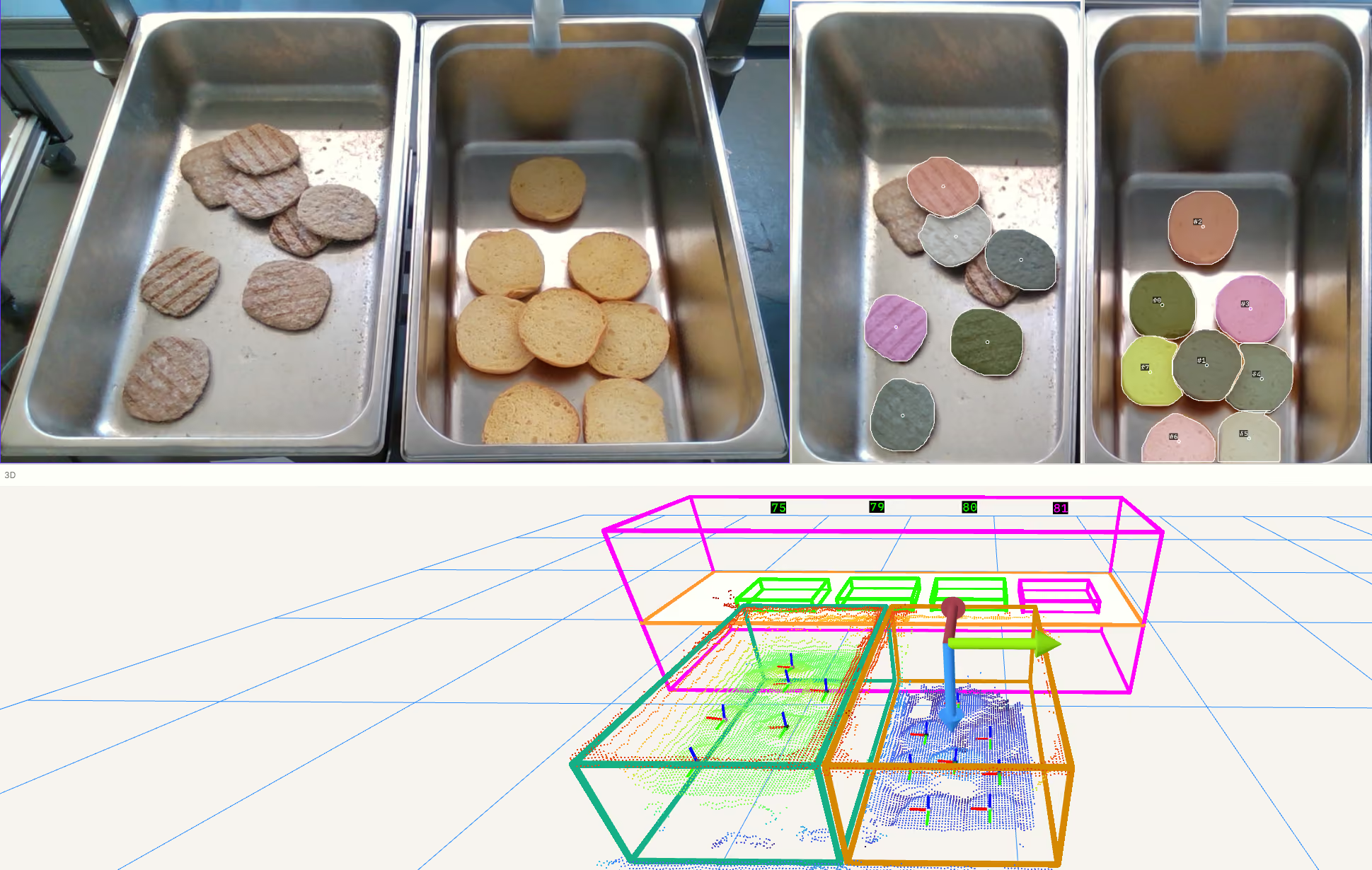
Chef robots use AI-powered segmentation and detection models combined with color image data from RGB-D cameras. This allows our robots to segment each ingredient piece in real time, determine its surface plane and normal vector, and determine the ideal picking pose (a combination of position and orientation). The utensil then precisely lifts and places the item into the right compartment of a tray or bowl. The robot intelligently picks in a way that minimizes disruption or movement of other ingredient pieces.
AI and computer vision enable our robots to pick from unstructured totes where pieces are randomly placed. Items don’t need to be neatly organized in a singulated tray or on a singulated in-feed conveyor. Instead, workers can just dump ingredients from a carton into a tote, and Chef robots can pick from it.
Further, unlike other solutions, Chef’s piece-picking solution isn’t custom-made for a single ingredient but is flexible enough to handle multiple ingredients. The AI model can be retrained to quickly switch between ingredients.
Robotics: Picking from a cluttered tote and placing with the right orientation
In a cluttered tote, ingredients aren’t neatly organized. They’re at different angles, and picking one piece affects the position and orientation of the next. With intelligent robotics:
- The robots can pick pieces at any angle, adapting to each item’s position and orientation rather than requiring them to lie perfectly flat.
- When depositing food items into meal trays, our robots can place each piece in a specific orientation, ensuring a chicken breast lies flat or a sauce cup sits upright.
Hardware: Custom suction-based utensil
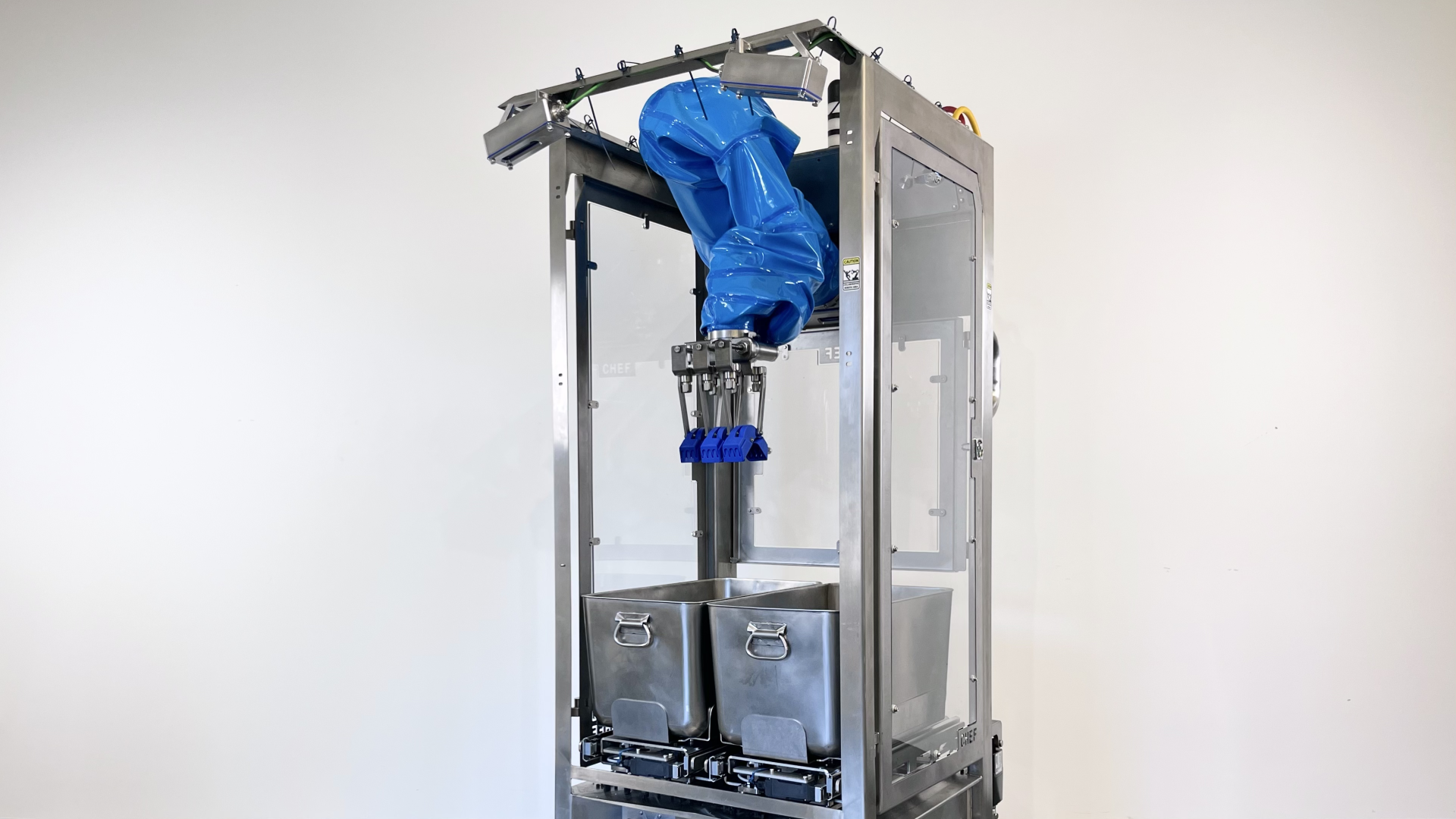
The piece-picking capability uses a food-safe, vacuum-powered suction cup that leverages the venturi effect to handle ingredient pieces. This creates a suction effect without pulling moisture into the vacuum, leaving the ingredient’s moisture level intact and ensuring the pneumatic system isn’t affected by any fats, oils, or liquids on the material. To prevent the entry of external particles during suction, each Chef robot has an air filtration system.
We designed the piece-picking utensil to reach ingredients across the entire pan, helping minimize leftovers when working with larger items. It comes with several attachments designed for different ingredient types—hard ingredients such as frozen patties and cutlets, and soft ones like pancakes and baked goods—ensuring gentle handling across all ingredient types. These attachments can be quickly interchanged without tools. Also, the end effector acts like a normal Chef “utensil” that a worker can change for any other utensil, allowing the same robot that scoops to do piece pick.
How piece picking helps food manufacturers
- Expanded ingredient range: With piece picking, the range of ingredients Chef robots can handle expands significantly. Food manufacturers who previously couldn’t automate certain ingredients due to their shape or individual handling requirements can now deploy robots across more SKUs. This increases overall utilization and increases labor productivity across assembly lines.
- Labor challenge solution: Manual piece handling (picking up each butter piece, placing each sauce cup, and positioning each protein cutlet) is repetitive and time-consuming. With staff turnover rates exceeding 150% in food manufacturing, piece picking provides a reliable solution for hard-to-staff tasks.
- 1:1 worker equivalent: Piece picking delivers a 1:1 worker equivalent, allowing food manufacturers to automate individual-item handling while maintaining consistent throughput. Our robots can match the pace and consistency of a line worker handling discrete items, providing a reliable automation solution that doesn’t compromise on production speed.
- Higher throughput: Our piece-picking capability benefits from Chef’s robot-to-robot (R2R) communication, enabling multiple robots to coordinate and distribute tasks for higher throughput. R2R lets multiple robots share piece-picking tasks by alternating between trays. Additionally, production lines can deploy both capabilities simultaneously—one robot handling scooped ingredients while another places individual pieces.
- Seamless addition for current customers: Piece-picking utensils are interchangeable with Chef’s scooping utensils. This allows for rapid and flexible changeovers.
What’s next?
Piece picking is now available for food manufacturers looking to automate the handling of ingredient pieces on their production lines. Some of our customers are already using piece picking for the assembly of fresh and frozen meals. As part of Chef’s robotics-as-a-service (RaaS) pricing model, piece picking doesn’t require any upfront capital investment and is included in our annual flat fee.
Contact us to learn how piece picking can expand automation on your production lines.
This is part 1 of a two-part blog post series. Read part 1 here.
.png)
.avif)