

How Project Open Hand Makes Medically Tailored Meals With Chef’s AI-Enabled Robots
The San Francisco-based nonprofit uses Chef robots powered by physical AI to address staff shortages and deliver consistent, medically tailored meals to people in need.

About Project Open Hand
Project Open Hand was founded in 1985 during the height of the AIDS epidemic, when a San Francisco grandmother began cooking meals for friends and neighbors too ill to cook for themselves. What started as a small act of compassion evolved into a formal nonprofit, rallying volunteers and community members to provide food to those living with HIV/AIDS.
Today, Project Open Hand carries that mission forward on a larger scale, preparing and delivering medically tailored meals and groceries to thousands of older adults and people living with serious illnesses like HIV/AIDS, cancer, and heart disease across the Bay Area. Four decades later, the organization continues to play a vital role in community health, supported by more than 125 volunteers daily who prepare, package, and deliver meals.


“The kitchen staff appreciate the reliability of the robots and the consistency of the pace of meal tray production. It prevents kitchen staff from having to come off of a kitchen cook line and fill trays. That’s a huge thing.”
Challenges
Project Open Hand faced several operational challenges common to high-volume, community-based food production environments. The organization’s reliance on volunteer labor, lack of consistency in meal assembly, and constantly changing menu made it difficult to maintain throughput and quality while meeting daily demand.

Project Open Hand’s meal production depends heavily on volunteers, with a new team managing production almost every day. As a result, the organization at times needed to pull cooks off the cooking line to assemble meals instead. Frequent volunteer turnover (given the very manual, repetitive nature of the plating work) also meant staff spent significant time training volunteers to portion and plate meals.

Before automating meal assembly, Project Open Hand volunteers were manually portioning meals using volumetric scoops, resulting in unavoidable, inconsistent weights and deposits across containers. Over or underportioned meals are particularly problematic for medically tailored meals, where precise portioning is of the essence. Due to the manual assembly process, the team wasn’t able to track accurate metrics on throughput, consistency, or aesthetic placement accuracy over time.

As Project Open Hand prepares new meals every day, the organization wasn’t able to use traditional fixed-automation systems that don’t adapt well to high-mix production environments and rapid changeovers. While the team had already automated part of their meal production with a conveyor system and a tray sealing machine, meal assembly remained a manual bottleneck. The manual meal assembly process limited throughput and made it difficult to maintain consistent portioning across meals.
Chef’s approach
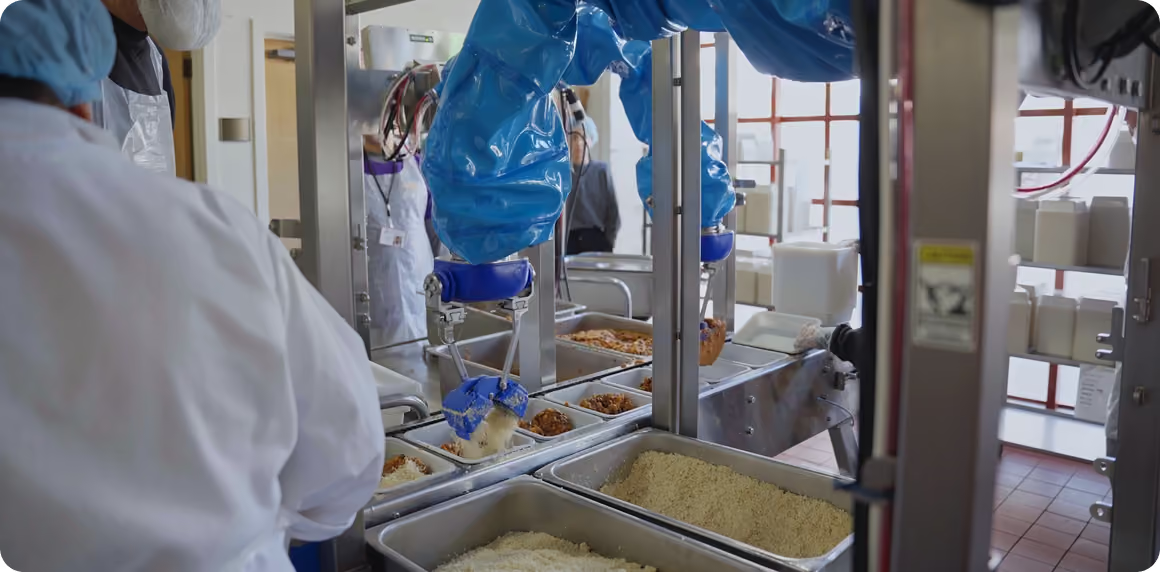
To overcome the above challenges, Project Open Hand decided to onboard two Chef robots on its single production line in San Francisco. The robots take up minimal space on Project Open Hand’s short conveyor line, working closely and safely alongside volunteers. Today, the organization has shifted from a seven-day to a five-day workweek and employs fewer volunteers for the daily meal assembly process. The Chef team designed its robots with the challenges of high-mix meal assembly in mind:
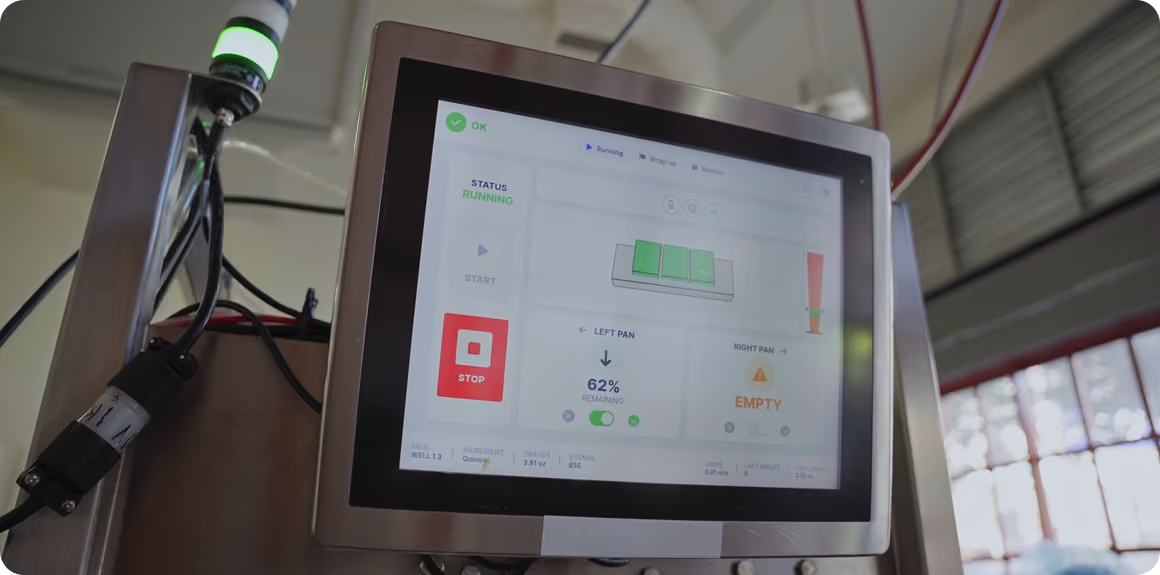
- AI-based perception: Chef robots are designed to handle the inherent variability of food ingredients.
- Per-pick metrics: Weight scales measure the weight of every pick, helping reduce giveaway.
- Ingredient and meal onboarding: Customers can quickly add new meals to the menu and onboard new ingredients to adapt to seasonality and changing production demand.
- Modular and portable: One robot takes up the same footprint as a person on the production line.
- Collaborative: The robots are safety-rated and can work safely alongside workers.
- Flexible: They can work with almost any ingredient, portion size, conveyor, tray, tray compartment, and insert.
- Real-time conveyor integration: Chef robots work with continuous belt and chain conveyors out of the box and can integrate with indexed conveyors in real time.
- Fully deployed in two weeks: Once the robots arrive at a facility, they can slide onto the production line and start assembling meals without any retrofitting or bolting required.
- Rapid changeovers: Switching from one ingredient to the next takes less than five minutes.
- Easy to clean: The only components that come into contact with food are the utensil and the pans. Both are easy to remove and replace without using any tools.

“Imagine every meal is your medication. Having a medication pill that was inaccurate would be like getting the wrong medication. Chef Robotics brings that level of accuracy at a per meal-level. When you’re talking about thousands of meals being produced, these are great areas of improvement.”
Impact
Just a few weeks after deploying Chef robots in its commercial kitchen, Project Open Hand was able to reallocate volunteers to other parts of its daily production work, monitor the consistency of its meals, and minimize food giveaway. The Chef robots accommodate five-minute changeovers while handling two unique ingredients each day from a rotation of 70 ingredients. Their ease of operation and flexibility to adapt to a high-mix production environment have made Project Open Hand’s workflows smooth and predictable.
Before adopting Chef robots, Project Open Hand relied on seven volunteers to assemble meals on its production line. With the two Chef robots in place, the team has been able to reallocate two volunteers to other tasks in its commercial kitchen (which also involve fewer repetitive motions) and maintain steady production, even on days with limited volunteer availability. The organization has been able to meet its daily throughput goals, with the Chef robots completing up to 4,550 servings across seven meals per week.
Since using the robots, Project Open Hand has been able to track yield and consistency for all 70 ingredients. For a nonprofit serving medically tailored meals, reducing giveaway and increasing consistency isn’t only about cost savings. Over-depositing food can mean that chronically ill clients receive too much of an ingredient they are advised to limit. In that sense, tracking these metrics is not just beneficial to Project Open Hand’s operations but essential to the quality of its meals and the integrity of its mission.
Beyond measuring yield and consistency for each ingredient, the Project Open Hand team receives real-time, reliable data at the bowl level, ensuring precise, repeatable deposits for every meal. This new level of visibility supports better demand planning and process optimization across the organization’s entire operation. It also lets the Project Open Hand team more accurately predict the computed nutritional values of each meal.
Download the in-depth case study
Read the full case study, including video interviews, detailed plots, data insights, and a comprehensive overview of Chef’s business approach.


