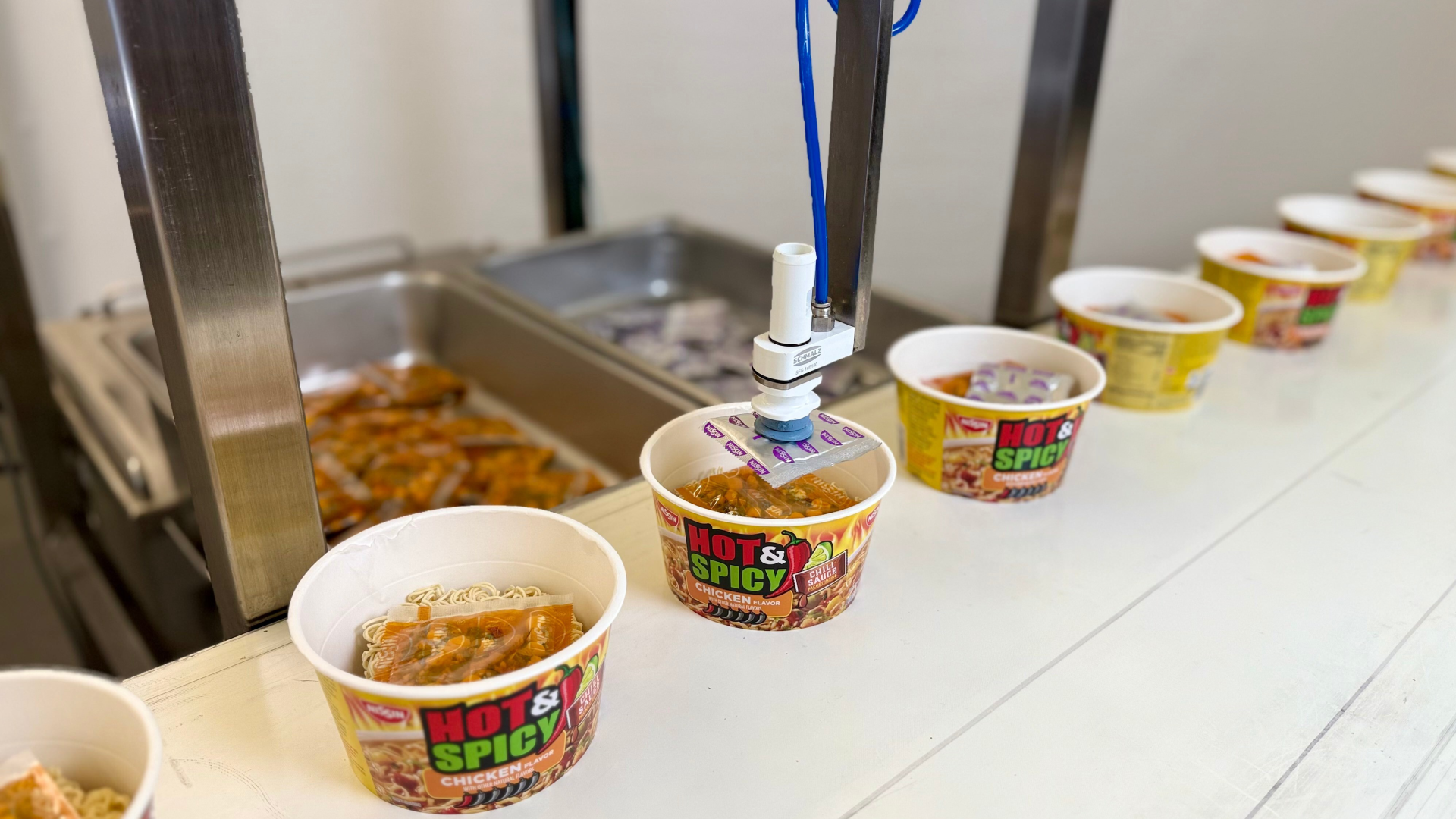
Picture an instant noodle bowl moving down a production line. The dried noodles are already inside. The next step is dropping in a liquid seasoning sachet, a dried garnish packet, and a seasoning oil pouch, each placed precisely into the bowl before sealing. All of this is still done by hand at most facilities. Sachets, packets, and toppers are lightweight and deformable: they crinkle, shift, and sit differently in a bin after every pick. This variability makes it challenging for automation systems to handle these items reliably at production speeds, leaving food manufacturers dependent on manual labor to staff this step.
Chef robots can now automate this step.
Chef’s physical AI models can handle secondary packaging and kitting automation for consumer packaged goods (CPG) lines by picking and placing discrete items—sauce sachets, seasoning packets, garnish toppers, dried proteins, foil-sealed pouches, and other irregular inclusions—into cups, bowls, trays, and packaging containers. The capability is not limited to edible ingredients; Chef robots can also place non-food inserts such as plastic-wrapped cutlery kits, desiccant packets, folded instruction cards, and even non-consumable items (i.e., shaving kits, accessory packs for MRE assembly).
The applications include assembling shelf-stable products like instant noodles and ramen bowls, multi-compartment trays, global meal kits with sauce pouches and bread accompaniments, premium snack cups with toppers, and any product that requires a cutlery drop.
How Chef’s physical AI models handle CPG component insertion
Chef robots handle CPG assembly using the existing piece-picking capability. Using AI-powered computer vision, a Chef robot assesses each item’s position, shape, and orientation in real time, whether it is a crinkled sachet lying at an angle or a nested cutlery pack stacked loosely in a bin. It then determines how to pick and place each item precisely into the correct location within each bowl, cup, or tray without damaging it. Chef’s physical AI models are trained across diverse real-world production environments, allowing the robots to adapt to pose variability in items within unstructured bins without requiring any pre-sorting or fixed bin placement.
The piece-picking capability uses a custom-designed, food-safe, vacuum-powered utensil with multiple quick-change attachments for different item types, including flat, flexible sachets and seasoning packets, as well as firmer items like packed cutlery and sealed topper inserts, ensuring consistent handling across the full range of CPG components.
Four AI-powered placement capabilities for CPG assembly
Secondary packaging automation requires more than picking and dropping items into a container. Depending on the SKU, operators may need to place items in designated compartments, assemble them as a complete kit in a single pass, or position them at precise orientations within each bowl or cup. Chef robots provide four distinct placement capabilities to meet these requirements:
- Precise angular placement: Many CPG products require each item to land at a specific orientation. A sauce sachet may need to lie flat with its tear-notch facing outward; a cutlery pouch may need to sit at a consistent angle within a side compartment. Chef’s vision system detects each item’s orientation in the bin and reorients it mid-pick so it arrives at the exact angle required, regardless of its orientation in the source container.
- Multi-item kitting: Chef robots can pick and place multiple components, for example, several seasoning sachets, into the same bowl in a single automated pass, completing the full kit without any manual intervention between picks.
- Compartment placement: For products with multiple compartments, each holding a different item, Chef robots place each component into its correct compartment. Chef’s AI vision model detects each compartment’s position and orientation in real time, ensuring each section receives the correct item without migrating into adjacent areas.
What this means for food manufacturers
CPG assembly lines that rely on manual labor to place sachets, packets, cutleries, and inclusions face compounding challenges: high turnover, inconsistent placement accuracy, and difficulty scaling headcount to meet production demand. Chef’s pick-and-place automation for CPG lines offers higher throughput, lower labor dependency, and consistent item placement across shifts. The capability runs on Chef’s existing robotic hardware and software, allowing food manufacturers to deploy it without changing existing line infrastructure.
What’s next
As more Chef customers deploy this capability, we will continue to expand coverage to additional item types and packaging formats across CPG categories.
Interested in learning more about Chef’s capabilities? Contact us to discover the full range of applications our robots are running for industry-leading food manufacturers.