
.avif)
Chef robots already deposit scoopable ingredients into small compartments and inserts on trays across meal assembly lines. For most ingredients like grains, sauces, finely chopped vegetables, and dry mixes, the existing combination of Chef’s shielded utensils and AI-powered vision works well. For finer, stickier ingredients like shredded cheese, however, the narrow target area and the ingredient’s flinging behavior introduce challenges that are harder to address with utensil design and computer vision alone.
Why are small compartments difficult for scoopable ingredients?
Small compartments leave little room for deposit error. The narrow target area reduces the margin for accurate placement, and sticky ingredients tend to cling to the outer portion of the utensil and between utensils after picking, increasing the risk of spillage into adjacent compartments. This is especially true for ingredients like sticky ingredients like cheese that fling when a utensil opens.
Today, we are introducing a deposit assist capability to address these problems.
What is deposit assist?
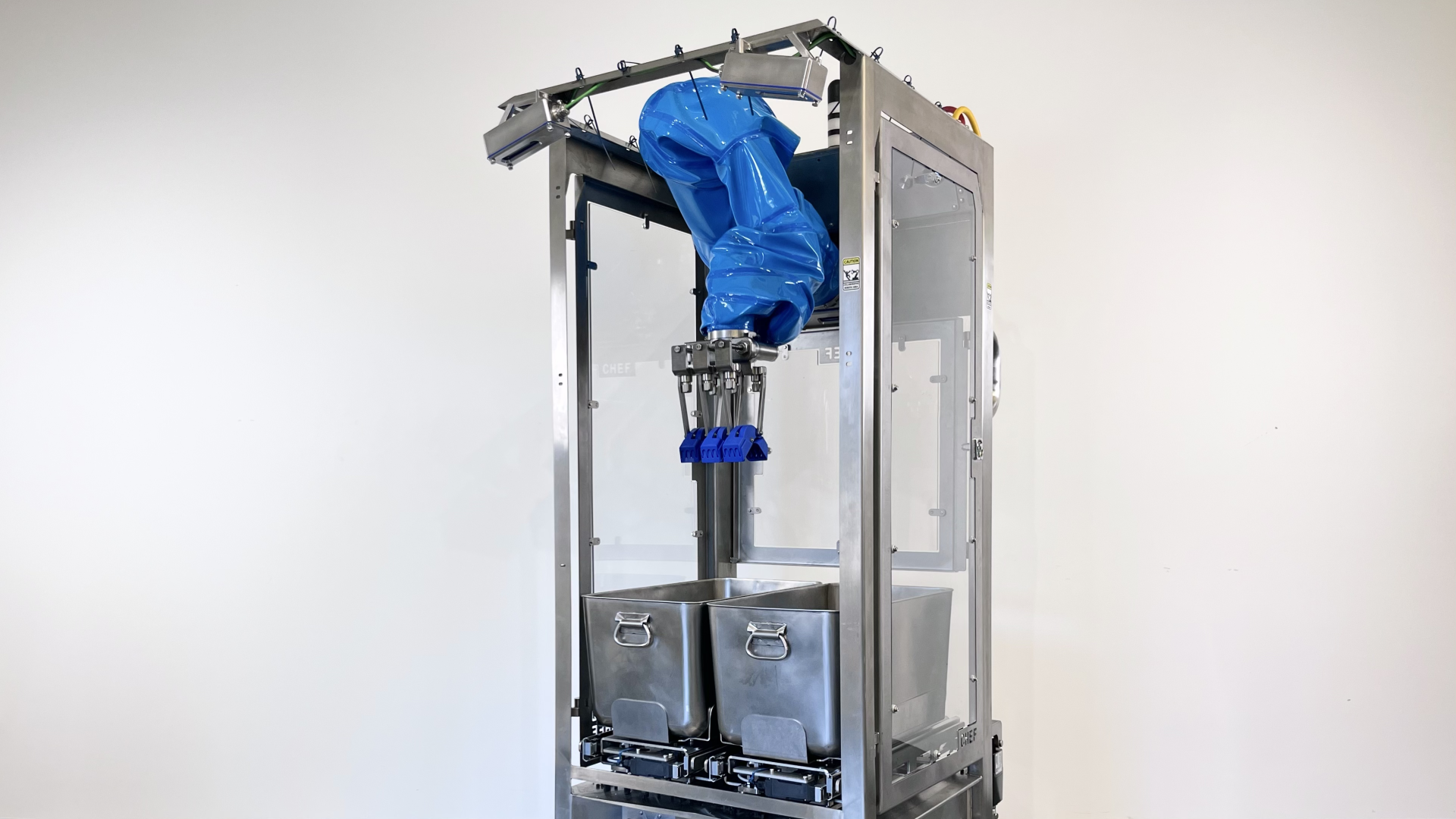
Deposit assist is a hardware attachment that food manufacturers can add directly to Chef’s end effectors. It acts like a funnel, guiding deposits into the target compartment more accurately and clearing leftover ingredients from utensils and between utensils that might have stuck during picking. This reduces spillage into adjacent compartments, ensuring every meal tray meets visual quality standards and is ready for sealing.
How does deposit assist work?
Deposit assist for directed deposits
Deposit assist is attached at the base of the utensil or across multiple utensils for multi-deposit configurations. It serves as a physical guide when the utensil opens to deposit an ingredient. As the utensil opens, the guard’s geometry deposits the ingredient toward the center of the target compartment, even when the compartment is small or irregularly shaped.
It can be customized to match the compartment size, the utensil size, and the number of utensils used, making it configurable across different tray formats and SKUs without requiring new robotic hardware.
Leftover ingredient clearing
After picking an ingredient, the robot shakes the utensil multiple times over the pan before moving to the deposit location. This removes any leftover ingredient stuck between the utensils, ensuring that the utensil carries only the correctly portioned amount to the target compartment.
We have attached an air cylinder actuator to the utensil, which is food-safe and NSF-certified, to control this motion. It is mounted on the utensil and connected to Chef’s existing pneumatic system. We have also added manipulation parameters to adjust the shaking motion depending on the ingredient.
What this means for food manufacturers
For food manufacturers, producing fresh ready-to-eat salads, multi-compartment ready-to-heat meals, or any product with small compartments or clear inserts, spillage into adjacent compartments and inconsistent portion weights are two of the most common sources of quality failure. Chef’s deposit assist capability and AI vision system address these without requiring changes to existing production line infrastructure or new robotic hardware.
What’s next
Contact us to discover the full range of applications our robots are running for industry-leading food manufacturers.
.png)
.avif)