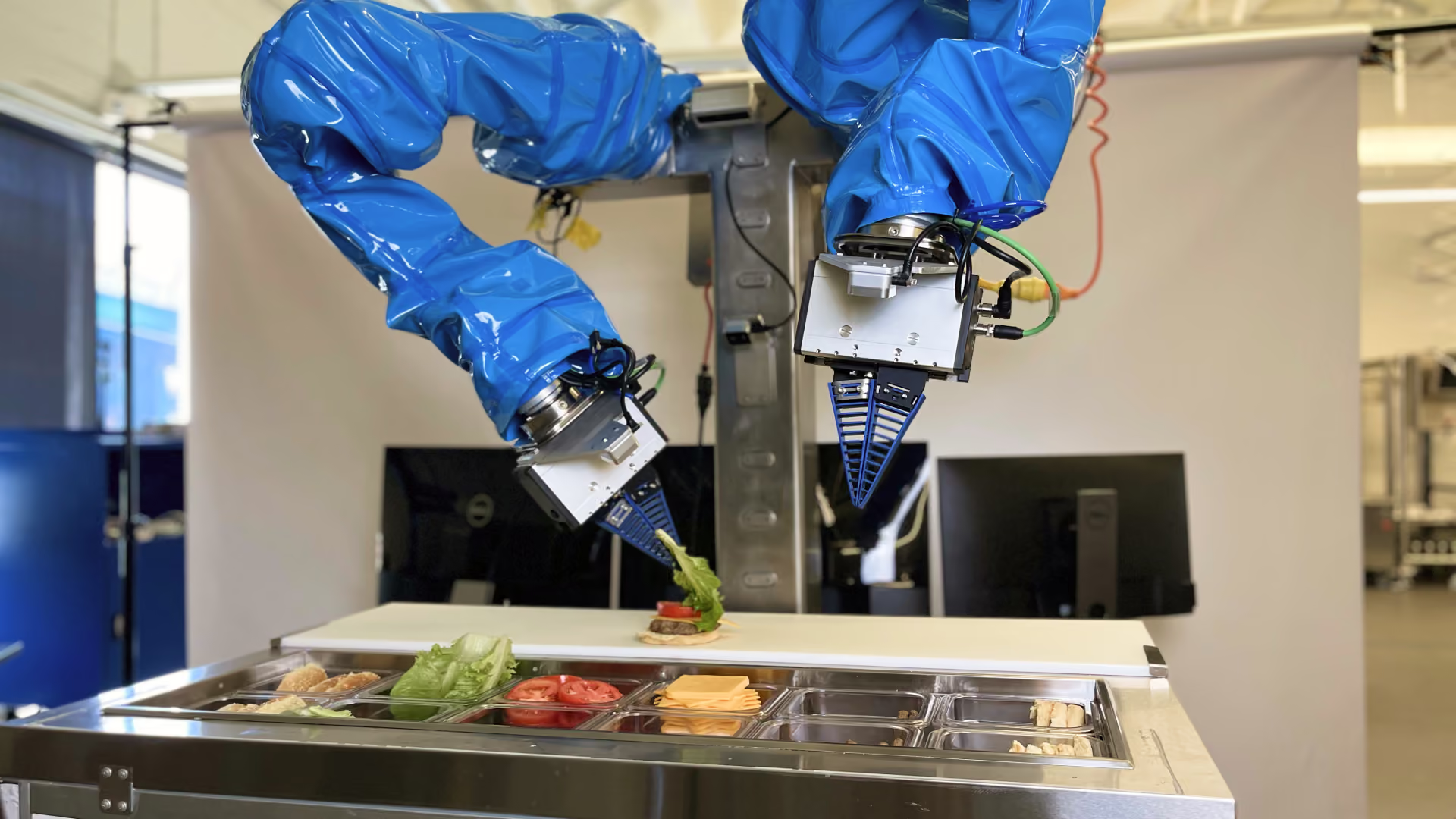
With the advent of physical AI and imitation learning, Chef’s AI team is developing a bi-manual physical AI system for prep table food assembly. We’re designing this new system specifically for ghost kitchens, fast-casual restaurants, airline catering, schools, hospitals, military, prisons, stadiums, corporate dining, and hotels.
Today, Chef robots handle high-volume meal assembly on food manufacturing conveyor lines. Our new bi-manual physical AI system will focus on lower-volume, higher-complexity meal assembly tasks on prep tables, such as back-of-house burger or burrito bowl assembly. These tasks are lower-volume but higher-complexity than food manufacturing on conveyor lines because a single worker (or robot) assembles an entire meal, rather than breaking the process down into separate workstations for each ingredient.
To perform higher-complexity tasks, our new physical AI system will feature two robotic arms enabling bi-manual control. It will be able to perform coordinated, dexterous manipulation tasks comparable to human arms and hands. The system’s end effectors will be flexible enough to pick up different food ingredients and utensils.
Powered by Chef’s Food Foundation Model (FFM)
Our new physical AI system will be powered by Chef’s Food Foundation Model (FFM), which learns faster and adapts to a wider range of use cases than traditional robotic systems.
Off-the-shelf vision-language-action models (VLAs) and physical AI models aren’t sufficient for food manipulation. Most VLAs and physical AI models are trained on rigid-body manipulation, but food manipulation involves highly variable, deformable materials (think wet, sticky, and irregular items). This requires our AI models to generalize across a broad range of physical states and interactions.
Instead of using separate models for tasks like picking and placing food, detecting trays, compartments, and inserts, handling scoopable or discrete ingredients, and figuring out how well our placement was for QA, our FFM supports all of these capabilities through a single “foundational” AI model. It can also be extended to new tasks more efficiently and with better performance compared to separate models.
Rather than being programmed, the FFM learns from demonstration (imitation learning) to perform specific tasks like assembling a burger or building a burrito bowl.
It also generalizes across different robotic hardware platforms by learning task representations that transfer across hardware embodiments (e.g., systems with different kinematics, end effectors, and configurations). In that sense, we’re building the physical AI layer for food. Over time, we expect to leverage our FFM for non-food use cases as well. Food is one of the most challenging materials to manipulate, so if we can handle food, we’ll be able to handle other deformable materials (i.e., pharmaceuticals, apparel) and non-deformable materials as well.
We expect the FFM to unlock additional capabilities over time. For example, it may support zero-shot or few-shot ingredient onboarding, adapting to new ingredients with minimal training. The model will also self-improve and autonomously increase yield and consistency over time.
See our FFM working on both Chef’s food-safe hardware and a research platform.
1. The FFM assembles a burger on Chef’s new physical AI system with food-safe hardware:
2. The FFM assembles a burger on Chef’s research platform:
3. The FFM assembles a burrito bowl on Chef’s research platform:
Other benefits
Beyond being designed specifically for prep table food assembly, our new physical AI system will be:
- Built using our proprietary hardware to meet strict food industry standards
- Food safe, wash-down, and able to endure various temperature and humidity conditions
- Collaborative, working safely alongside workers
- Easy to use, as Chef’s FFM is language-prompted
“We started Chef by focusing on high-throughput food manufacturing, but a large part of the industry still relies on manual prep table assembly,” said Rajat Bhageria, Founder and CEO of Chef Robotics. “These environments are more complex and less structured, which makes them harder to automate. With this new physical AI system and our Food Foundation Model, we will extend physical AI to handle those real-world conditions and unlock a much broader set of applications in the food industry.”
.png)
.avif)