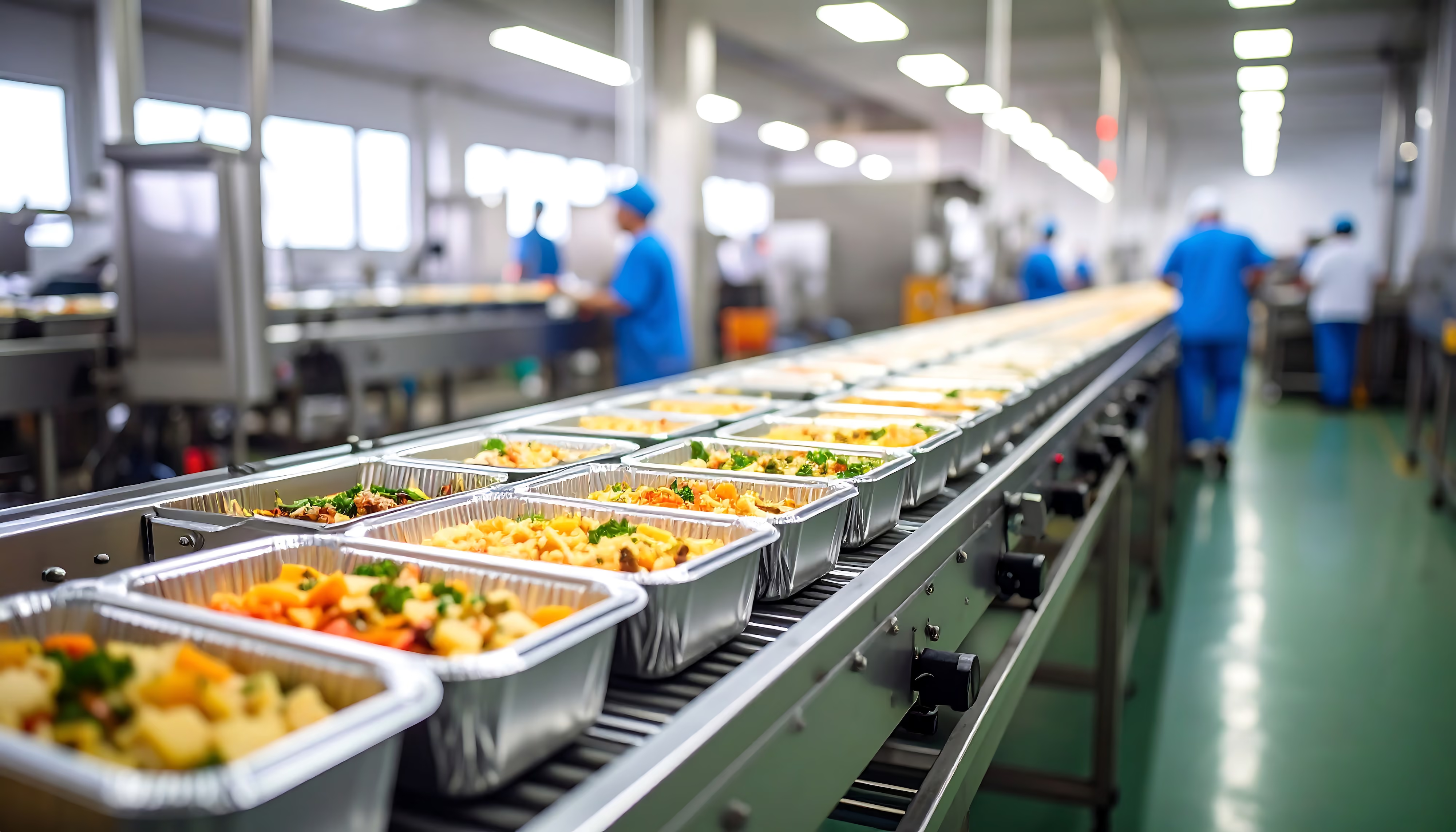
Food production lines run meals from denesting through case packing, but manufacturers also need equipment that catches contamination, verifies weights, mixes ingredients, and prints compliance labels.
Choosing the wrong equipment creates new problems. For example, an overly sensitive metal detector may reject good products and disrupt production, while mixers intended for bakery dough may struggle with viscous sauces. Similarly, scales lacking proper IP ratings can trap moisture and bacteria, making them less suitable than more robust alternatives.
Here’s a breakdown of essential equipment that solves these problems. This is part two of our guide to food processing equipment manufacturers. After exploring production line automation equipment—from denesting through case packing—in Part 1, this section moves ahead to cover supporting equipment that ensures products meet safety, quality, and compliance standards.
Metal detectors and X-ray inspectors
Metal fragments from worn equipment parts, broken mixer blades, or facility infrastructure can enter production lines and threaten food safety. Even a tiny metal fragment can lead to recalling an entire production batch (thousands of units), incurring huge costs for the manufacturer.
To avoid this, manufacturers use metal detectors and X-ray systems on their production lines. Metal detectors use electromagnetic fields to catch ferrous and non-ferrous metals, as well as stainless steel. X-ray inspectors catch what metal detectors miss—glass shards, bone fragments, and stones—which matters for products like bone-in proteins or items in aluminum trays that interfere with metal detection.
Leading companies:
- Fortress Technology manufactures metal detection systems with IP69K washdown protection. Their Contact 4.0 platform logs every detection event for FSMA compliance. These detectors come in pipeline, conveyor, and gravity-fed configurations.
- Loma Systems manufactures the IQ4 range with multi-spectrum detection, reducing false rejects by 30-40% while maintaining sensitivity to small contaminants. These detectors are IP69-rated and available in conveyor, pipeline, and vertical fall configurations.
- Mettler Toledo manufactures X-ray inspection systems that detect contaminants that metal detectors can’t catch. Their Safeline Profile series runs at speeds up to 200 meters per minute while detecting 2 mm glass fragments and bone pieces.
Checkweighers
Tray weight errors create two problems: underweight trays violate USDA/FDA labeling requirements, leading to recalls, and overweight trays result in significant yield losses for the manufacturer.
Manual spot-checking catches obvious errors but misses gradual overfilling or underfilling. Checkweighers weigh every tray, automatically reject out-of-spec units, and log weight data.
Leading companies:
- Loma Systems builds the CW3 checkweigher series with an IP69 rating. They handle products from 50 g sachets to 60 kg cases at speeds up to 200 units per minute and reject units by pushing them off the conveyor belt.
- Mettler Toledo builds multi-lane checkweighers that weigh trays on 4-8 lanes simultaneously for high-speed lines, eliminating the need for a separate checkweigher for each belt. They integrate metal detection or X-ray inspection into their checkweighers, cutting footprint by 40%.
Vision inspection systems
During quality checks on production lines, human inspectors slow down after 2-3 hours and miss defects at speeds above 60 units per minute. Defects such as a missing fork in a meal tray, a torn seal, or a foreign object on a product surface can slip through manual inspection but lead to customer complaints and retail chargebacks.
Vision systems use industrial AI-powered cameras to inspect products at line speed. They verify meal components, detect packaging damage, confirm label placement, and spot foreign objects.
Leading companies:
- Cognex builds vision systems with deep learning. Their In-Sight systems inspect at speeds up to 150 parts per minute and are rated IP65 and IP69K for wet environments. They store images of failed inspections for HACCP documentation (as evidence of food safety compliance).
- Keyence builds the CV-X and VS Series with built-in AI that learns defect patterns from 20-30 example images. These systems achieve 0.5-mm position verification accuracy, detect contamination spots as small as 1 mm, and maintain performance even when ambient lighting changes.
Industrial weighing scales
During ingredient batching, a 2% measurement error in salt or spices affects an entire batch. Customers notice taste differences, or products fail sodium regulations.
Manufacturers need food weighing scales that maintain accuracy through temperature swings, vibrations, and after daily washdowns. These scales range from bench scales for small ingredients to floor scales for bulk ingredients.
Leading companies:
- Mettler Toledo builds bench scales, floor scales, and formulation systems with POWERCELL technology that compensates for temperature changes and vibration. These scales carry IP65 to IP69 ratings, offer a 0.1 g resolution, and come with legal-for-trade certifications.
- Rice Lake Weighing Systems builds scales from 30-lb bench scales to 10,000-lb floor scales with stainless steel construction and sealed load cells. These scales carry NTEP legal-for-trade approval and use sloped surfaces that cut cleaning time.
Vibratory feeders
When working with bulk ingredients, manufacturers need controlled, consistent flow from hoppers into mixers, fillers, and packaging lines. Manual or gravity feeding disrupts the flow, introduces contamination risk, and lacks the precision or gentle handling required for fragile products.
Vibratory feeders, including vibratory bowl feeders and linear feeders, use electromagnetic or mechanical vibration to move dry bulk ingredients at controlled rates. They handle everything from powders and granules to larger pieces, maintaining consistent flow without crushing or degrading products.
Leading companies:
- Eriez manufactures electromagnetic vibratory feeders with dual vibratory action. Hopper vibrators eliminate ingredient clogging while the feeder vibrator controls ingredient discharge rates. Their HD (High Deflection) series handles heavy-duty applications, from fine powders to leafy products, with food-grade construction designed for food-processing washdown environments.
- Syntron Material Handling produces volumetric feeders with variable-speed controls for accurate material delivery. Their electromagnetic designs operate at 3,600 vibrations per minute and feature dust-proof, splash-proof drives that withstand steam cleaning.
Mixers and blenders
Ingredient mixing directly affects product consistency, texture, and shelf stability. Undermixing leaves ingredient pockets that create batch variation. Overmixing can damage product structure or generate excessive heat. Different products—dry seasonings, sauces, bread doughs, dairy emulsions—require different mixing and processing mechanisms.
Industrial mixers come in several types: ribbon blenders handle dry ingredients through a gentle folding action, planetary mixers work for doughs and batters with rotating and orbiting motion, and high-shear industrial mixer machines process emulsions and suspensions that require intensive blending.
Leading companies:
- Charles Ross & Son manufactures ribbon blenders from 2 to 500 cubic feet, planetary mixers up to 750 gallons, and high-speed dispersers that run at 3,000+ RPM. Their equipment uses tri-clamp connections and polished stainless steel that meets 3-A standards.
- Hobart provides mixers from 20-quart countertop units to 140-quart floor models. Their legacy series uses gear-driven transmission instead of belt drives, eliminating a common failure point, and features bowl-lift systems that lock bowls into place for safe operation.
Homogenizers
Emulsified food products like milk, sauces, and beverages naturally separate—fat globules rise and particles settle, creating inconsistent texture, appearance issues, and reduced shelf life. Mechanical mixing alone can’t prevent separation because it doesn’t reduce particle sizes enough to maintain stability.
High-pressure homogenizers force liquids through small valves at extreme pressures, breaking particles down to micrometer- or nanometer-sized particles. Industrial homogenizers are critical for dairy products, plant-based beverages, salad dressings, and other emulsions that require long-term stability.
Leading companies:
- GEA manufactures high-pressure homogenizers for the food industry, including dairy, beverage, and processing applications. Their Ariete series industrial homogenizers handle flow rates from small-scale to production capacity.
- Tetra Pak produces the Homogenizer 500, the highest-capacity food processing homogenizer available, with serial cooling systems that reduce water consumption by 80%. Their homogenizer equipment processes both high and low-viscosity products.
Cooking & processing equipment
For large-batch cooking, manufacturers require specialized food processing equipment with precise temperature control and uniform heat distribution. Uneven heating burns some ingredients in hot spots while leaving others undercooked. When cooking 10 to 100+ gallons at once, manual stirring can’t maintain the required consistency.
Steam-jacketed kettles circulate steam around the vessel for even heating without a direct flame. Braising pans provide large, flat surfaces for browning and simmering. Both use sanitary construction that withstands repeated washdowns.
Leading companies:
- Cleveland Range manufactures steam kettles, braising pans, and tilting skillets for commercial and institutional kitchens. Their equipment ranges from countertop models to 100-gallon floor units with thermostatic controls and 316 stainless steel construction for corrosion resistance.
- Groen produces steam-jacketed kettles with capacities from 5 to 1,000 gallons, available with various agitator configurations for different product types. Their systems use 316-grade stainless steel and include features such as automatic fill-and-drain systems and precise temperature control.
Blast chillers and cooling equipment
Hot-cooked products that cool slowly are more prone to bacterial growth, creating food safety risks and quality loss. Slow cooling also affects product quality—proteins lose moisture, and flavors degrade.
Blast chillers use high-velocity cold air to rapidly reduce product temperature from cooking temperature to safe storage temperature in 90 minutes or less. This quick cooling prevents bacterial growth, preserves texture and moisture, and extends shelf life.
Leading companies:
- Victory Refrigeration manufactures blast chillers with probe-based temperature monitoring that meet federal food safety regulations. Their systems include both under-counter and upright models with electronic controls and various pan capacities.
- Irinox manufactures blast chillers and shock freezers with operating cycles from +85°C to -40°C. Their systems use R290 refrigerant, which has a low environmental impact, and include programmable cycles for different product types and applications.
Labeling equipment
For labeling, meal trays need lot codes, production dates, and barcodes for regulatory compliance and recall traceability. If the codes are smudged or misaligned, they fail barcode scanners at distribution centers, leading to rejected shipments.
Print-and-apply systems apply pre-printed labels. Thermal transfer systems print directly onto labels or flexible film. Inkjet and laser systems print onto cases, bottles, or cans.
Leading companies:
- Markem-Imaje builds print-and-apply labelers that apply up to 150 labels per minute, thermal transfer printers for flexible film, and continuous inkjet systems for case coding. This equipment prints GS1-compliant barcodes and logs all print jobs for traceability.
- Videojet builds continuous inkjet printers that print at speeds up to 1,000 feet per minute, and fiber laser systems that mark permanent codes on glass and metal. Systems connect via Ethernet for remote monitoring.
Making the right choice
The food production equipment covered here prevents contamination, ensures batch consistency, and maintains compliance. It is important for food manufacturers to address the constraints that create the highest risk. For example, facilities with frequent recalls start with inspection equipment, while facilities with inconsistent batches start with scales or mixers. Many facilities add one system at a time, see results, and then expand.
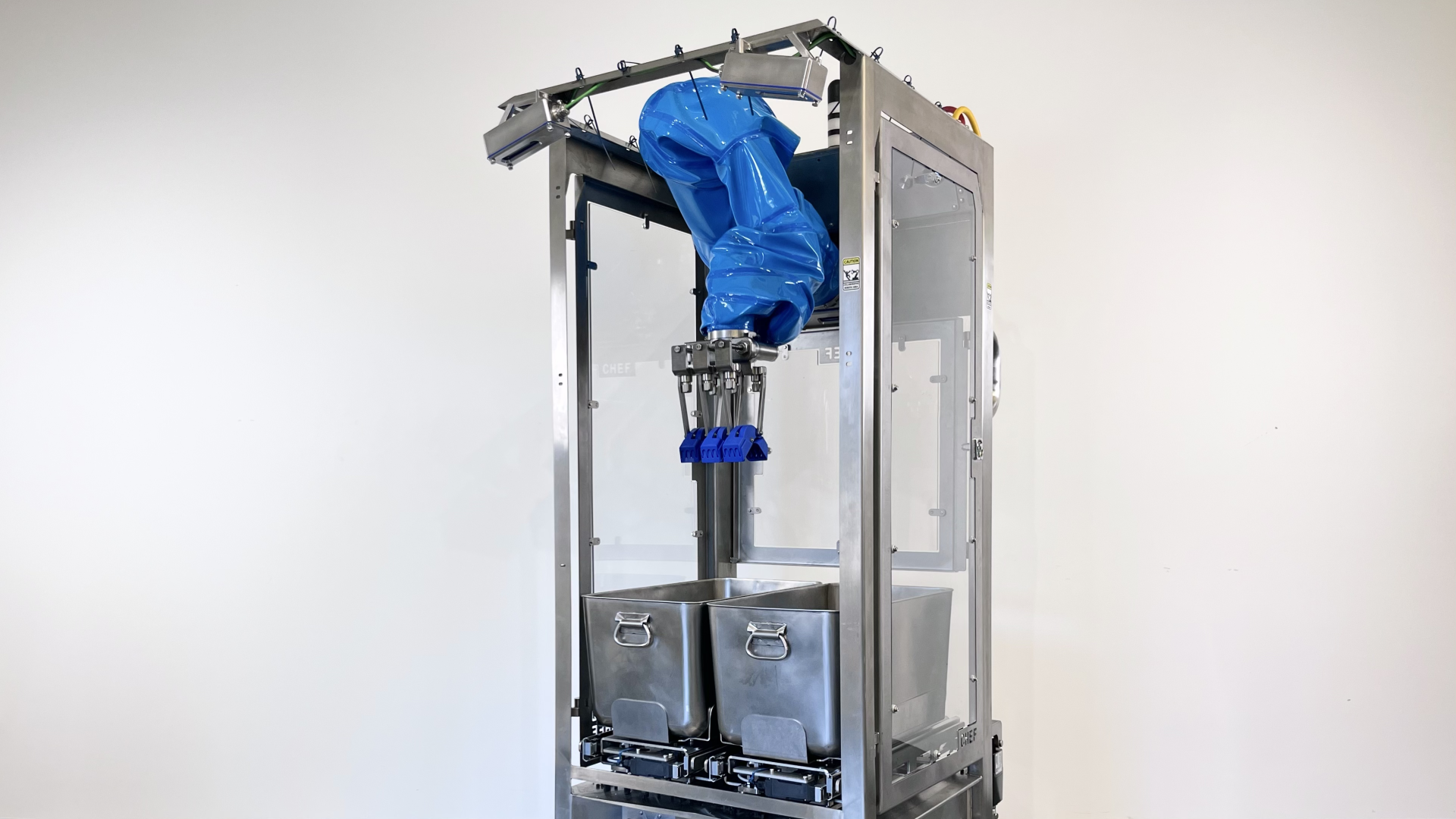
Looking for food inspection, quality control, processing, or labeling equipment? Contact the food equipment manufacturers listed in each section to discuss your specific requirements. For meal assembly automation (covered in Part 1), contact Chef Robotics.