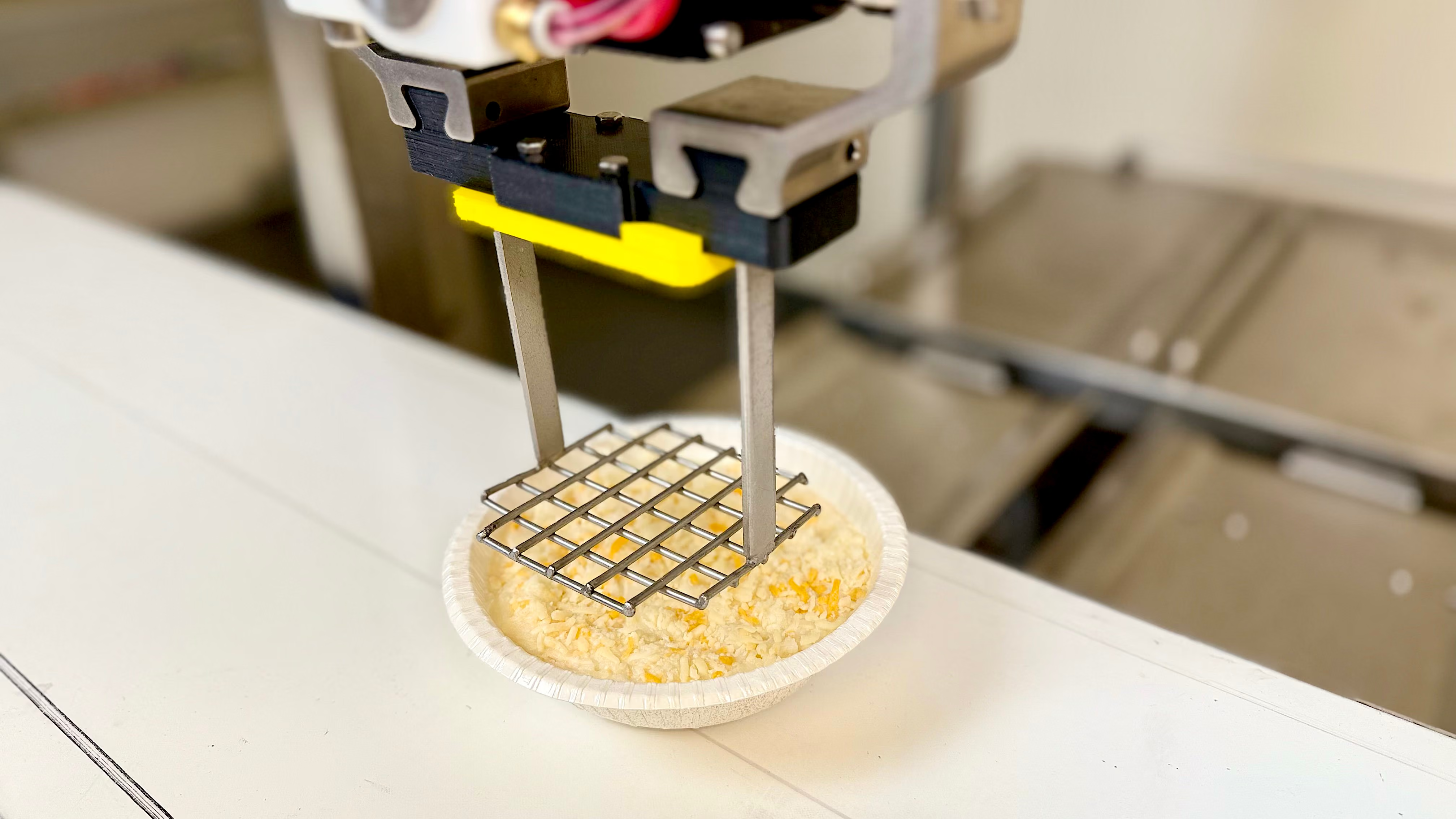
Chef’s pat-down capability helps food manufacturers automate the manual task of spreading and flattening ingredients in prepared meal trays before sealing, ensuring consistent presentation. By automating this repetitive task, food manufacturers can reduce sealing issues, minimize waste, and improve the aesthetic quality of their meals. This new capability is compatible with existing Chef robots and requires no new infrastructure.
Ingredient placement challenges
Food companies face growing pressure to deliver more packaged meals while maintaining consistency, safety, and visual appeal—all while navigating labor shortages and turnover rates exceeding 150% annually. When workers deposit ingredients into meal trays, the ingredients naturally settle in the center, creating an uneven, bulging appearance. This leads to sealing issues, limited space for other ingredients, and compromised product aesthetics. To achieve uniform coverage before sealing, manufacturers rely on line workers to manually flatten food inside each tray—a repetitive task that leads to fatigue, repetitive stress injuries, and higher labor costs.
Beyond the labor cost, inconsistent manual spreading creates downstream problems. Unevenly spread meals cause spillage during sealing, leading to machine downtime, rejected trays, and food waste. For manufacturers who already face labor shortages, these inefficiencies cause even more strain on daily operations.
The limitations of traditional automation
While some traditional automation systems can spread or flatten meals, they only work in limited scenarios. They require indexed, cleated lines for identically positioned trays or simple "bowl or no bowl" phototransistor sensors on continuous belts that are prone to failure. These solutions cannot handle real-world production variables such as line stoppages, speed changes, or malpositioned trays, which is why manufacturers have historically relied on manual labor for pat-down tasks.
The solution
Chef’s new pat-down capability addresses three critical challenges:
- Consistent meal presentation: Pat-down ensures 100% tray coverage for consistent aesthetics and customer appeal—essential for meals where presentation is critical.
- Prevented sealing issues: By spreading food consistently, food manufacturers can prevent spillage during tray sealing. This reduces downtime on sealing machines, results in fewer rejected trays, and minimizes food waste.
- Reduced costs: Pat-down automates a strenuous, repetitive task, freeing up workers for higher-value operational activities while lowering overall production costs.
How pat-down works
Our new pat-down capability is compatible with all existing Chef robots. We designed a flat, cross-slotted utensil and end-effector stack that vibrates; in tandem, the utensil and vibration help spread and flatten ingredients inside trays. This new utensil is interchangeable with Chef’s depositing utensils and features a cleanable, rounded-edge design that meets food safety standards and rigorous cleaning protocols.
Using AI-powered computer vision software, Chef robots detect and track trays on the conveyor, understanding their position and orientation in real time. Chef’s intelligent detection software allows our robots to handle variations in tray positions, line stoppages, and speed changes—the real-world conditions that traditional automation cannot manage. Once a line worker inserts the pat-down utensil and selects the “pat down” function on the HMI screen, a robot automatically flattens meals rather than picking and depositing ingredients.
Maximizing production throughput
Our pat-down capability benefits from Chef’s robot-to-robot (R2R) communication, enabling multiple robotic units to coordinate and distribute tasks to increase throughput. R2R lets multiple robots share pat-down tasks by alternating between trays, allowing facilities to process more units per minute and achieve higher production volumes. Additionally, the same production line can use robots for both meal assembly and pat-down operations, with one robot depositing ingredients while another flattens meals.
What’s next?
Pat-down is now widely available to food manufacturers. Chef customers such as Amy’s Kitchen are already using the capability to ensure consistent presentation for frozen meals like mac and cheese. As part of Chef’s robotics-as-a-service (RaaS) pricing model, pat-down does not require any upfront capital investment but is included in our annual flat fee.
Ready to integrate AI-enabled food manufacturing automation into your meal assembly lines? Contact us to learn more.
.png)
.avif)