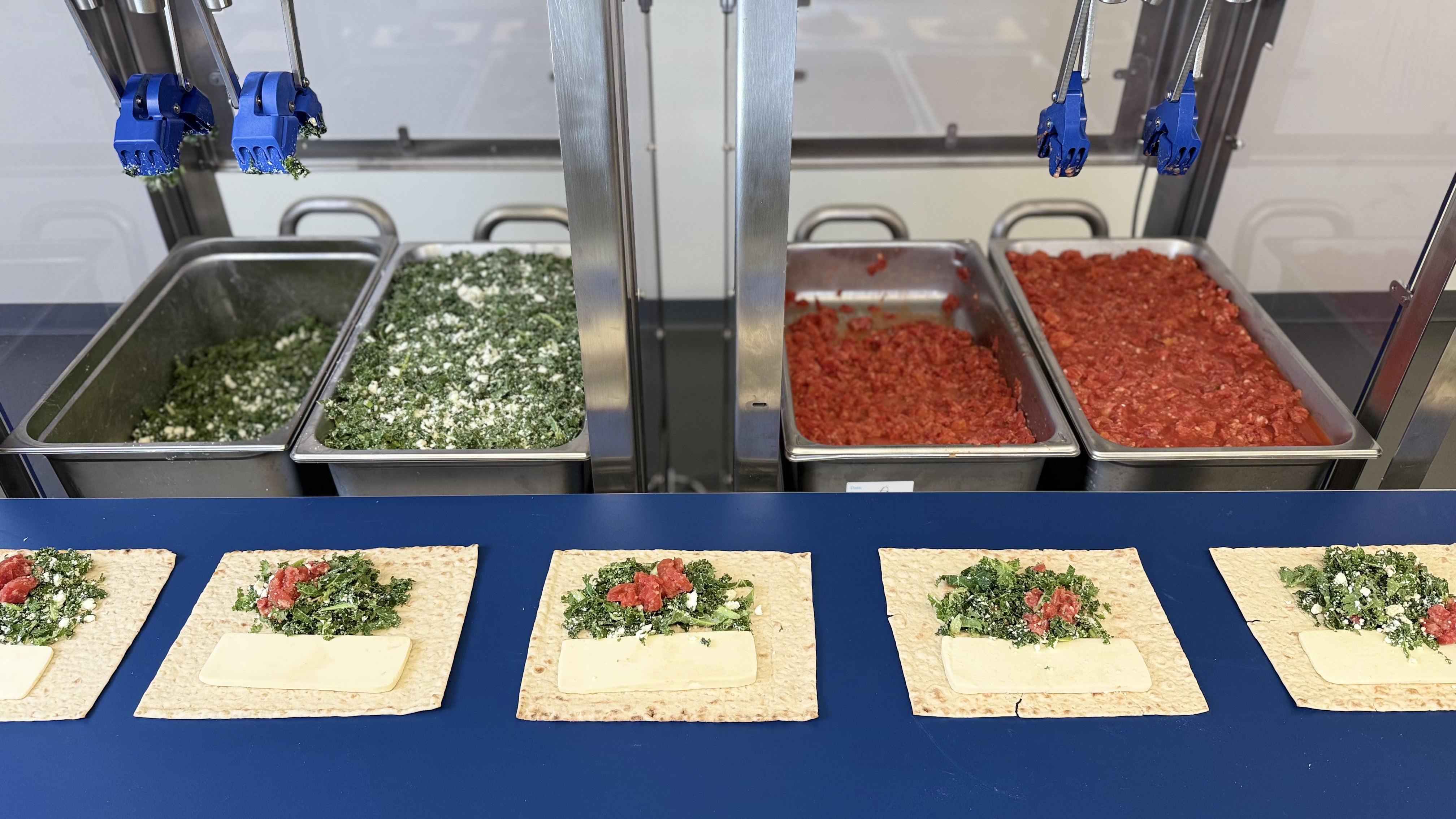
When Chef robots place ingredients into trays or bowls, even if they have inserts, they operate within defined geometries—fixed shapes, clear boundaries, and known depths—making it easier to detect trays on a conveyor and deposit ingredients precisely into each compartment.
However, not every product on a food manufacturing line has defined geometries. For wraps, burritos, burgers, and pizza assembly, Chef robots need to place ingredients such as meat, cheese, rice, and vegetables on flatbreads, including wraps, tortillas, lavash, naan, pita, sandwich bread, burger buns, and pizza bases. Our robots need to detect those flatbreads as they would a tray and place ingredients precisely, without spillage, to avoid problems in downstream processes like folding, stacking, and sealing.
For example, a burrito line may require protein and rice to be placed along a center line for consistent rolling, while a sandwich line may require ingredients to be centered on a piece of bread.
Why are flatbreads more challenging than trays
- Inconsistent geometry: The edges of tortillas and other flatbreads may be slightly folded, stretched, or misaligned on the conveyor, and these irregularities can vary vastly between different product types.
- Flat surface with no boundaries: Unlike trays or bowls, flatbreads don’t have physical boundaries. Chef robots need to detect the edges of each and place ingredients accurately without sacrificing throughput.
- No depth: As flatbreads have little to no depth, they often blend visually with the conveyor, making them more challenging to detect with camera-based vision systems.
- Unpredictable placement: On flat surfaces, ingredients may spill or shift, unlike trays with walls and compartments.
- Large footprint: A wrap or tortilla may be significantly larger than a tray, increasing the placement area. This requires the robot arm to travel further from its base and, in some cases, spread ingredients across the base, both of which can slow down throughput.
How Chef robots solve this problem
Adapting perception to flat, flexible products
Chef robots use AI-powered vision systems to detect trays and bowls. Given that flatbreads lack height, our robots can’t rely on height cues to distinguish each flatbread from the conveyor. Instead, they rely on subtle visual cues like edges, textures, and shapes.
This capability is built directly into Chef’s robotic perception system. We have trained our AI vision models on large-scale image and sensor data collected across diverse production environments, enabling our robots to automatically generalize to new conditions.
These models allow Chef robots to reliably detect flatbreads in real time on a moving conveyor, even with variations in shape, size, and orientation. This way, our robots can accurately identify edges, including when products are skewed or partially folded, ensuring consistent detection without missing flatbreads.
Maintaining throughput despite larger placement areas
Since flatbreads are larger than trays, the robot arm needs to travel farther from its base each time it places ingredients and, in some cases, spread ingredients across the base, increasing cycle time. Maintaining the same speed therefore requires our robots to operate faster and, in some cases, increase conveyor speed. To allow our robots to detect and track flatbreads at higher speeds while still placing ingredients with high precision, we increased the camera refresh rate. The perception system can now capture more frames per second as flatbreads move down the line.
Placement strategies based on meal requirements
Depending on the type of flatbread, Chef robots dynamically adjust:
- Drop height to control spread vs. concentration
- End-effector motion to match placement patterns (point, line along the wrap, or distributed)
- Timing and trajectory to stay aligned with conveyor speed while minimizing spillage
For example:
- Wraps and tortillas typically require ingredients to be placed along a line or at a specific point to support consistent folding. In such cases, Chef robots deposit from a lower height to keep ingredients concentrated and move their robotic arm along a linear path for greater control over placement.
- Sandwich bread and burger buns require ingredients to be centered on the bread to ensure clean stacking and minimize spillover. This applies to both scoopable items (e.g., scrambled eggs) and discrete items (e.g., meat patties, cutlets). In such cases, our robots use lower-pressure dispensing with a controlled utensil opening to keep the deposit centered.
- Pizza and flatbreads often require toppings to be spread across a larger surface. In such cases, our robots deposit from a higher position and use controlled utensil motion to evenly distribute ingredients.
What this means for food manufacturers
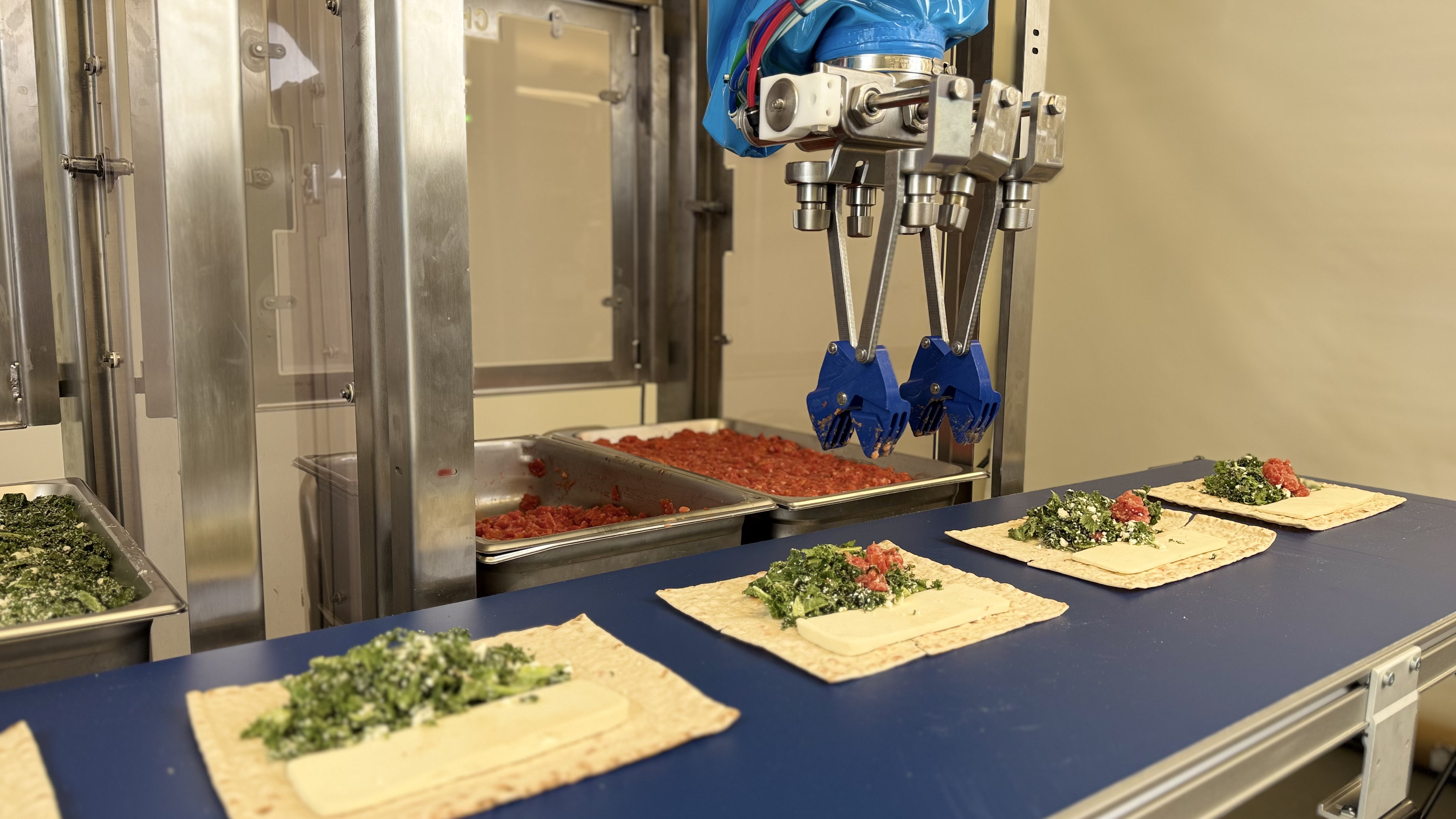
By using Chef robots, food manufacturers can extend automation beyond structured trays and bowls. This includes wrap fillings, burrito assembly, sandwich production lines, burger assembly, pizza assembly, and most other flatbread assembly.
Chef’s automation solution works across a wide range of flatbread types and formats, and allows food manufacturers to handle the same range of ingredients used in tray-based meal assembly without modifying existing line infrastructure. This way, food manufacturers can maintain speed and precision while handling a highly variable assembly base that has historically been difficult to automate.
What’s next?
Several Chef customers are already using our robots to place ingredients on flatbreads in production environments, and we are continuing to train our models on more real-world data.
If you’re a ready meal manufacturer looking for burrito, wrap, sandwich, or burger assembly production line equipment, we’d be happy to discuss how Chef robots may fit into your production workflow. Get in touch with our team to learn more.
.png)