
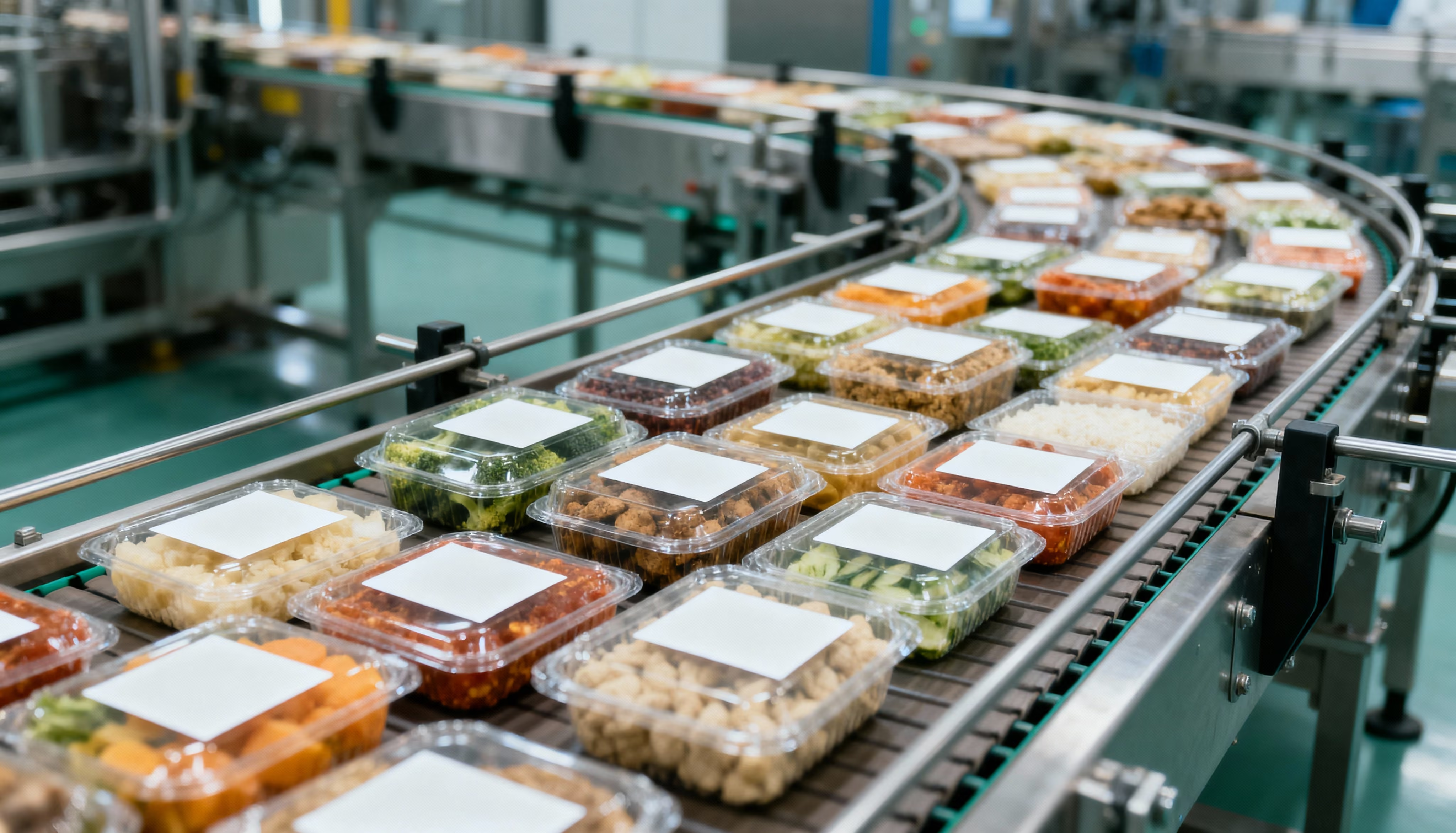
Food manufacturers are under pressure from every direction. Labor shortages, high turnover, and rising SKU variability are making it harder to maintain throughput, consistency, and profitability.
As a result, automation has become a priority across the food industry. But not all automation systems solve the same problem, and deploying the wrong system can introduce new challenges instead of alleviating them.
Here’s a breakdown of the leading companies for each major food manufacturing operation: de-nesting, conveying, meal assembly, packaging, and case packing. Understanding each solution’s specialization and the constraints the food manufacturing equipment solves will help you identify the right automation partners.
De-nesting systems
Many food manufacturers employ a line worker to manually de-nest and place trays or bowls onto each conveyor line. Unfortunately, manual tray placement can be inaccurate and inconsistent, and it doesn’t scale well to meet higher-throughput goals. Manual denesting can also cause repetitive strain injuries, adding concerns about workers’ well-being.
Automated denesting systems use vacuum suction or mechanical grippers to pick individual trays from nested stacks, separate them without damage, and place them at consistent intervals on the conveyor. This eliminates manual tray handling, maintains steady line throughput, and reduces the risk of tray damage or contamination from repeated human contact.
Leading companies:
- QUPAQ specializes in tray denesting and tray handling (positioning and distributing trays after denesting). They accommodate a wide variety of tray sizes, shapes, and materials without requiring custom tooling for each tray type.
- MGS Machine Corporation offers tray and tub denesting, with both vacuum and rotary screw options. Their systems come with customizable sanitary levels designed for fast cleaning in harsh production environments.
Conveyor systems
Many food manufacturers move trays manually between production stages. Workers fill trays at fixed stations, then carry or slide completed trays to the next stage. This creates workflow bottlenecks—trays pile up at busy stations while workers wait at others. Manual tray movement also introduces handling variation that affects consistency and slows throughput as production volume increases.
Conveyors automate tray movement through production lines. They transport trays either with a continuous belt or chain motion, or with stop-and-go indexing that aligns with other production equipment on the line.
Most food-grade conveyors require standard electrical power and compressed air and can integrate into existing layouts without major facility modifications. They also need to meet strict sanitary requirements and must be easy to clean, prevent bacterial growth, and comply with food safety standards. Equipment design affects how much downtime cleaning adds to the production schedule.
Leading companies:
- Dorner offers FDA-approved food-grade conveyor belts with tool-less disassembly, reducing sanitation time by up to 50%. Their AquaGard and AquaPruf platforms allow quick belt changes without tools, making cleaning safer and faster for operators.
- FlexLink offers modular hygienic conveyor systems designed to eliminate bacterial hiding spots by removing horizontal surfaces, cavities, and hollow bodies. This design approach reduces re-cleans by up to 90%, cutting downtime and water usage.
- QC Conveyors specializes in sanitary conveyor systems with sealed motor and drive components that prevent contamination. Their DuraSeal conveyors feature stainless steel construction and designs that eliminate food traps, making them suitable for washdown environments and facilities with strict hygiene requirements.
Meal assembly
Meal assembly is the stage where ingredients are portioned and placed into trays or containers. The equipment needed for this operation depends on production patterns—facilities running the same product all day (low-mix) face different challenges than those switching between dozens of SKUs (high-mix) per shift.
Low-mix, high-volume production
Facilities running consistent products in high volumes use traditional portioning equipment designed for speed and accuracy on uniform ingredients. These systems portion single or low-mix ingredients efficiently when SKUs don’t change frequently and ingredients maintain consistent characteristics. The changeovers for these types of equipment typically require hours for mechanical adjustments, nozzle changes, and recalibration.
Top manufacturers:
- Ishida manufactures multi-head weighers that combine multiple weight heads to achieve accurate target weights at high speeds, commonly used for snacks, frozen foods, and consistent dry ingredients.
- Triangle Package Machinery offers multi-head weighers and volumetric fillers for high-speed portioning of uniform products across bakery, snack, and frozen food applications.
- Vemag specializes in vacuum filling and portioning systems for proteins, dough, and paste-like products, delivering consistent portions at high throughput.
- Marel provides weighing and portioning solutions for proteins and prepared foods in high-volume production environments.
- All-Fill manufactures piston fillers for sauces, liquids, and viscous products, and auger fillers for powders, granules, and dry ingredients like spices and coffee grounds.
- AMS Filling Systems specializes in auger fillers for powders and granules, handling everything from fine powders to granular products with volumetric or gravimetric filling modes.
High-mix production
Most meal assembly lines run dozens of SKUs daily, each with different ingredients, portions, tray sizes, and placement requirements. Many food manufacturers rely on manual labor—workers portioning ingredients by hand into trays. Manual assembly offers flexibility but creates challenges with labor availability, portion consistency, giveaway savings, and throughput as volume increases.
The problem when automating is turning to the same equipment used for decades: volumetric fillers, check weighers, auger fillers, and linear vibratory feeders. These systems work well in high-volume, low-variability environments, but in high-mix production, changeover times make them impractical. When ingredients vary—different protein cuts, varying vegetable sizes, inconsistent densities—these systems can’t adapt without manual intervention.
Leading solution:
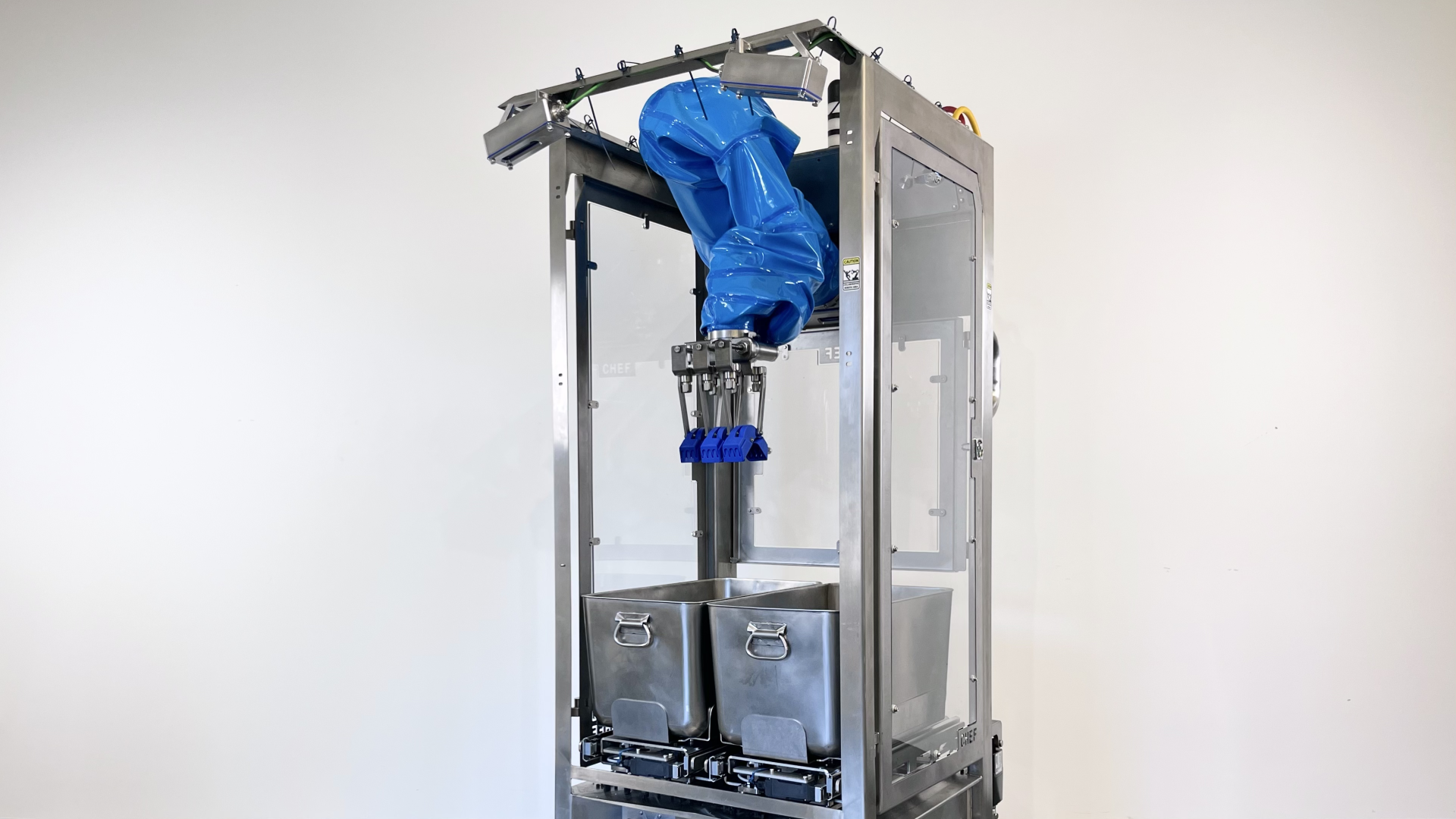
Chef Robotics has built AI-enabled robots for meal assembly that flexibly automate production lines. Unlike traditional depositors and dispensers that operate at fixed positions regardless of tray orientation, causing spillage and waste, Chef robots use AI and computer vision to adapt to food variability and tray positions in real time.
Chef robots track moving trays on the conveyor and adjust for skew, speed changes, and placement variations. They handle hundreds of ingredients, including starches (e.g., basmati rice, mashed potatoes), proteins (e.g., beef birria, diced tofu, shredded chicken), leafy greens (e.g., romaine, shredded cabbage, spinach), vegetables, curries, sauces, and cheeses, without requiring any infrastructure changes. When switching between meals, operators simply swap the utensil, completing changeovers in under a minute.
Chef robots have assembled over 80 million servings in production and have continuously learned from production data to improve their AI models. Customers have achieved 2-3x increases in production, up to 88% reductions in food waste, and up to 30% better portion consistency.
Sealing & packaging
Once meals are assembled in trays, they need to be sealed to maintain freshness and extend shelf life—a critical part of the food packaging production line. Tray sealers are essential food packaging equipment that apply a film or lid to trays and can be configured for ambient sealing or modified atmosphere packaging (MAP), which extends shelf life by flushing trays with gas, or vacuum skin packaging (VSP).
Top manufacturers:
- Proseal (part of the JBT Corporation) specializes in high-performance tray sealing systems for fresh and prepared food applications. Their machines are widely used across ready meals, proteins, and produce, supporting a broad range of tray materials with advanced MAP and skin-pack capabilities, and are known for precision sealing, high throughput, and strong hygiene-focused design.
- ILPRA (Distributed by RTG Packaging in North America) specializes in tray sealers for ovenable and microwave-safe applications. Their machines handle CPET, mono-PET, and other materials ideal for prepared meals that consumers heat directly in the tray, with MAP and VSP capabilities.
- Packline Solutions Group offers tray sealing systems ranging from semi-automatic to high-speed configurations, handling up to 120 units per minute. Their PAO and PAO-Q platforms support modified atmosphere packaging and flexible membrane sealing, designed for reliable performance across fresh foods, ready meals, and protein applications.
- Ossid (Distributed by Reepack in North America) offers fully automatic and semi-automatic tray sealers with quick changeovers. Their ReeEco model features three loading positions and handles ambient, MAP, and VSP sealing in a compact footprint. The system operates on electricity without requiring compressed air.
Case packing & palletizing
Case packing and palletizing are essential end-of-line processes. Case packing equipment erects cardboard boxes, loads sealed trays or products, and seals cases. Palletizing systems then stack these cases onto pallets for efficient shipping and storage. Integrating automated food packaging systems reduces manual handling, increases throughput, and ensures consistent stacking patterns for stable transport.
Industry leaders:
- Schneider Packaging Equipment provides robotic case packers and palletizers that handle case erecting, packing, sealing, and palletizing. With 50+ years of expertise, their robots handle 30-100 cases per minute and are well-suited for 24/7 production environments.
- BW Packaging specializes in palletizing systems and offers both conventional and robotic palletizing systems. Their robotic palletizers can handle multiple SKUs in both ambient and frozen environments, without extensive reconfiguration.
- Brenton provides complete case packing and palletizing solutions, including erecting, packing, sealing, and palletizing. They deliver the fastest changeover times in the industry and can integrate all functions into a single compact frame, ideal for space-constrained facilities.
Making the right choice
The companies listed here operate across different stages of food production—from tray handling to final palletizing. Choosing the right automation in food manufacturing depends on your specific challenges and the operational constraints that limit your production capacity.
Food processing lines that run low-mix, high-volume ingredients benefit from equipment that is optimized for speed. High-mix facilities that switch between multiple SKUs need systems that minimize changeover time.
Food manufacturing facilities also need to adhere to strict sanitation protocols, which affect cleaning times and can add pressure to the production schedule. Equipment that is designed for fast cleaning reduces downtime between runs. This matters particularly in facilities that run raw proteins, where deep cleaning occurs multiple times per day.
Lastly, manufacturers should consider their production environment when choosing automation equipment. Equipment designed for ambient temperatures often fails in cold rooms due to condensation and thermal stress on various components.
Although food manufacturers have a lot to consider when choosing automation equipment, the advantage is having a range of options that address specific challenges tailored to different production environments. Many facilities automate one stage at a time, see results in throughput or consistency, then expand to other areas. Partial automation often delivers faster ROI than waiting to implement a complete solution.
Looking for food processing equipment manufacturers? Reach out directly to the companies listed in each section. For meal assembly automation, reach out to Chef Robotics.
.png)
.avif)