
Chef robots pick and place multiple ingredients into trays. Food depositors accurately deposit a single ingredient. Here's how the two compare.
Food depositors (also called food dispensers, piston depositors, filling machines, sauce depositors, or volumetric depositors) are excellent at depositing one flowable ingredient such as sauces, dressings, batters, and fillings, at high speed. But they fall short in high-mix meal assembly for two reasons. First, they are unable to handle many ingredients, such as diced proteins, vegetables, grains, and mixed foods. Second, even for ingredients they can handle, like sauces, changeover and cleaning time makes them impractical when SKUs switch several times a day. Chef robots pick and place ingredients using AI-powered computer vision, handle multiple SKUs with quick changeovers, and automate meal assembly on a single production line.
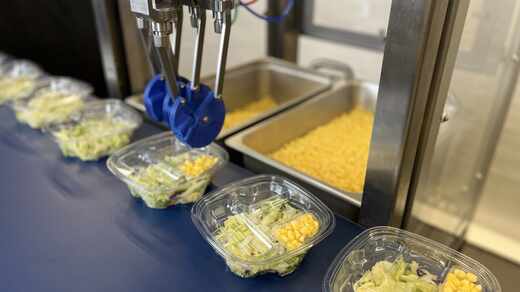
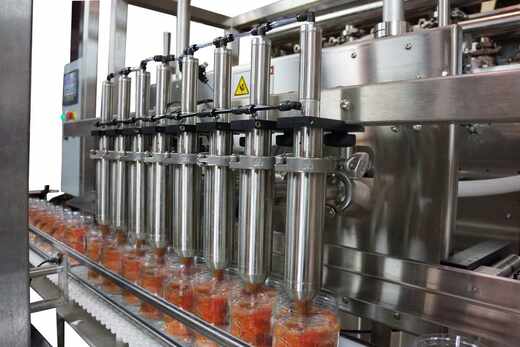
Chef robots and depositors are both food portioning equipment, but they solve different problems: Chef robots assemble a complete meal in high-mix operations, while depositors dose a single ingredient. That difference determines which one fits your production line.
| Criteria | Chef robot | Food depositor |
|---|---|---|
| Overview | Picks and places multiple ingredients into tray compartments | Deposits one ingredient into a fixed location using a nozzle |
| Ingredient flexibility | Handles hundreds of ingredients on the same robot | Configured for a specific ingredient per depositor |
| Ingredient compatibility | Handles proteins, vegetables, grains, starches, cheeses, sauces, curries, fruit, and mixed foods | Best for flowable ingredients such as sauces, batters, dressings, fillings, and pastes |
| Portioning | Portions by weight with automatic correction for each pick | Portions by volume; air pockets and food chunks cause weight drift |
| Changeover time | Manufacturers switch ingredients and recipes in minutes by swapping the utensil and pan and selecting a new recipe | Changeovers take hours; switching ingredients requires cleaning the full ingredient contact path and reconfiguration |
| Food safety | Only the pan and utensil get in contact with food ingredients | Food comes in contact with the hopper, cylinder, valve, tubing, and nozzle |
| Ideal use case | High-mix meal assembly with frequent SKU changes | High-volume runs with one consistent ingredient |
A food depositor, often called a piston filler or volumetric depositor, uses positive displacement to portion food products. A piston moves inside a cylinder, draws a fixed volume of product from a hopper, and pushes it out through a nozzle. Each deposit delivers the same volume of ingredient regardless of viscosity. Each depositor is set up and calibrated for one specific ingredient.
Chef customers often run all three side by side: depositor machines for sauces, Chef robots for pick-and-place ingredients, and line workers for the steps neither can help automate. Chef automates the meal assembly steps depositors are unable to; Chef does not replace every machine on the line.
Manufacturers who move to Chef robots for meal assembly automation see:
Only to a point. Depositors portion by volume, so chunks and air pockets cause weight variation. Wider cylinders and agitators help, but consistency is still a problem for ingredients that are not smooth and uniform.
Commercial food depositor pricing depends on nozzle count, automation level, and integration, and vendors quote each project individually. A simple manual unit starts under $10,000. A fully automatic inline system from a brand like Hinds-Bock, Unifiller, or Vemag can cost well over $100,000. Depositors are purchased as capital equipment and are paid upfront.
Chef's meal assembly and food portioning robots eliminate upfront costs. Through a robotics-as-a-service (RaaS) model, manufacturers pay a single flat annual fee that covers the robots, software, and support, priced below the labor they replace.
A depositor is built around one ingredient's flow characteristics and one nozzle position. Every additional ingredient on the tray means another depositor, another calibration, and another teardown cleaning at changeover.
Most manufacturers add line workers to place what depositors are unable to. The alternative is a pick-and-place tray filling machine — a robot like Chef's meal assembly robots, which pick and place multiple ingredients into specific tray compartments and handle multiple SKUs with quick changeovers.
Send us your meal and tray format, and we'll show you how Chef robots would run on your line.
Request a demo